Showing posts with label graphic books. Show all posts

An appropriate occassion for a return

I have been away for this blog for too long because [insert usual description of RL interference with blogging responsibilities here], but some synchronicity compels a few remarks.

It had been a while since I have even bought a comic; I finally caught up with Comic Book Comics from Evil Twin and was very disappointed, but more on that later. But the other day I was in one of my LCS, and this cover caught my eye:


Arrowsmith: So Smart in their Fine Uniforms

Wildstorm: 2004
by Kurt Busiek, Carlos Pacheco, Jesus Merino, and Alex Sinclair

What caught my eye first was the sort of art nouveau design sensibility; as I leafed through the book, I could see that it was some sort of alternate history WW1 story, and something about it just hooked me. I took it home and read it over the next few days.

It turned out to be a well-done (if fairly typical) story of an idealistic young man who goes off to war for noble reasons and discovers that it is difficult to keep his moral stance in the middle of the horror of battle. The difference is that alongside traditional armaments, both sides use magic - sometimes nasty magic.

The book is beautifully drawn, the alternate world fully realized, and the characters engaging; the plot, however, could have been lifted from any of a number of war movies, and without much alteration would work just fine without any of the magical or other alternate history elements. Yet I feel the book is a worthwhile addition to the genre and well worth a read, for two reasons.

The first is that is is extremely well-done. Although the plot mechanics may be a little trite, Busiek's actualization of the trope is sophisticated and compelling. He makes us care about the characters and lets us feel their pain, their growth, their joys, and their losses. Within the fantasy realm, he paints as strong a picture of the realities of war as I think anyone could, and Pacheco's art more than meets the challenge of carrying the weight of the story. It is truly a tour de force for both creators.

Perhaps more importantly, the book called me to read it and to be open to its message. As jaded as I can be at times, I might not have read just another anti-war war book; I mean, there was All Quiet on the Western Front and Paths of Glory and Johnny Got His Gun and yeah, I've been there. But the alt-history pulled me in, and then the book slapped me in the face with a heaping dose of reality and made me think clearly again about about something incredibly significant, and made me feel again how I feel about it. And that is a good thing to have happen, and a nice achievement for any Art, whether fine, pop, or junk.

That this book made this statement to me on this particular weekend just made it all the more meaningful.

I guess Arrowsmith may be old news to some, but it was a new discovery to me; I suggest you check it out if you ever have the chance.

80pg. Giant

Twelve-step review:


Samurai: Heaven and Earth - Volume 2
by Ron Marz, Luke Ross, Rob Schwager, Dan Jackson, and Dave Lanphear
Dark Horse: 2007


1. Our story continues the adventures of Shiro, a misplaced samurai fighting his way across early eighteenth century Europe in search of his lost love, Yoshi. In this arc, Shiro makes his way though Spain, across the Mediterranean, and then across North Africa from Tripoli to Egypt.

2. Shiro picks up an ally of sorts on his journey: the Arab slaver who initially brought Yoshi from her captivity in China to Europe. They even get a "meet cute" moment:


3. Shiro's partnership with Al-Din and his need of the trader's local knowledge and contacts serve to somewhat mitigate the sometimes omnipotent nature of the character. There seems to be no army that Shiro cannot defeat singlehandedly; I wanted to see him succeed more by guile or determination or experience and less by just being better than everyone else.

4. Marz's script now include flashbacks to Japan at the start of every chapter. I think that this device works even more effectively in the collection as it would have in individual issues; the two "stories" merge nicely at the end of the book. Notwithstanding Shiro's unstoppability, Marz paces the quest and cliffhangers that appear throughout the plot well.

5. Don Miguel, the duplicitous Spanish ambassador from the first book, is developed further as a villain of major standing, and Yoshi is given more time of her own to shine.

6. The language issue that I mentioned in my review of the first book is given minor attention, but is still never really addressed. That's still okay.

7. The issue of Yoshi's sexual experiences while in captivity, on the other hand, is addressed directly, forthrightly, and in a sophisticated adult manner. Kudos.

8. Luke Ross's art is still totally gorgeous. The shift in setting to North Africa allows him to indulge himself in a whole different collection of set pieces and determining shots. Somebody referred to this part of the series as Shiro of Arabia, and it has the same epic sweep as the David Lean film. The people are still beautiful to look at as well.

9. In addition to the flashbacks mentioned above there is another device that I think works better - or only - in the collection. Page six of chapter one (a full-page spread) is perfectively and effectively echoed on page eight of chapter five. I'm not sure this would have been as compelling if I had seen the images four months apart rather than less than an hour. (It is precisely this kind of effect that the form of the physical text has on narrative that I might use as my research focus for my doctorate.)

10. The book contains another great slew of bonus features: design sketches, unused cover concepts and a gallery of the characters by different artists.

11. The most interesting feature in the extras will be incorporated into my class on comics nd sequential art next quarter: Ross penciled one fight scene as a two-page spread, and then had to re-arrange the panels when he realized the scene would actually fall on the recto and verso of the same page. It is a great example of the interplay of narrative, art, panel design, and page layout in comics.

12. I don't think it's too much of a spoiler to let you know that the lovers are re-united - at least for a time: there are clearly more struggles ahead and another five-issue arc is promised. I'll sure be waiting for the trade.


Not a review

I picked up a copy of Fantastic Four: The Lost Adventure #1. This book, billed as a Stan Lee/Jack Kirby production, takes an unpublished story by Stan and Jack and presents it three ways: as reproductions of the original pencils, complete with marginal notes; within a different published story that used some of the panels and pages - out of context - as a flashback sequence; and as the complete story as it was originally intended to be seen back in 1970, with post facto production assistance from contemporary professionals. I find this a wonderful piece of work, if only for its glimpse into the creative and productive processes that go into a comic book. This will be another text for the class to consider.

Five-star review:


Justice League: The new Frontier Special #1
by Darwyn Cooke, J. Bone, and David Bullock


1. This is not so much a review as a love letter. Darwyn Cooke just gets superheroes better than anyone else at DC and has a design sensibility and visual elan than I just can't get enough of.

2. Cooke's fight between Superman and Batman in the main story makes you realize just how silly and self-indulgent Frank Miller can be, and was even back in The Dark Knight Returns. Cooke, on the other hand, provides a slam-bang action story without sacrificing any character consistency. Cool beans, indeed.

3. I grow more and more in love with Cooke's Wonder Woman. Man-o-man, wotta woman!


4. The Robin and Kid Flash team-up tale was everything that I had hoped The Teen Titans Lost Annual was going to be, and wasn't. Haney's magic didn't survive him, and that post-mortem concoction just fell flat. This story, however, is an hommage, not a reproduction, and it positively zings; can you dig it, daddy-o?

5. The rest of the issue was full of more fun: a pitch-perfect Rip Hunter intro; a frothy, funny Wonder Woman-Black Canary-Gloria Steinem (!) team-up; some behind the scenes art from the New Frontier DVD; and the hidden jewel of the piece: a National Comics in-house ad from an Elseworld where John Henry and Martian Manhunter had their own ten-cent comics alongside Green Lantern.

Compare and contrast

I went to see the Persepolis movie today.

Y'know, I have to say that I was never a big fan of the book. It was the Seattle Public Library's "Everybody Reads" pick a few years back, and I even gave a talk on "How to Read a Graphic Novel" in conjunction with that event that used the memoir as its centerpiece, but I never really thought it was that good. Marjane Satrapi clearly has a compelling story to tell; I just don't think that she is that accomplished as a storyteller. The book doesn't really exploit the potential of the form, the art doesn't captivate me, and the story seems to just chug along without much momentum. Maybe I'm missing something, but I never quite got what all the fuss was about.

The film, on the other hand, has some magical moments, is beautifully visualized, and has condensed the story into a tighter narrative arc that moves briskly. It was not a great film, but surely a good one. When I came home, I took another look at the books, and realized that the parts that seemed to work the best for me on the screen were those parts that deviated the most from Satrapi's original vision on the page. I don't know if she just had wonderful collaborators or if film is her true medium, but the movie is so much better than the comic that it is hard to figure out. I'll have to give this a lot more thought (and maybe ask my students!).

Meta

It seems this little corner of the blogoverse must have passed some sort of threshold, because I am starting to get some solicitations for reviews, which has never happened before. This really isn't primarily a "new stuff" blog, so I don't think I'll be going that way, but I wanted to share a piece of the latest request I got, verbatim:

I was wondering if you would be interested in reading it and perhaps giving it a review on your "internet web-log."

So, is that the subtlest irony ever or genuine?

Twelve-step review: Samurai: Heaven and Earth


Samurai: Heaven and Earth
by Ron Marz, Luke Ross, Jason Keith, and Dave Lanphear
Dark Horse: 2006


1. Shiro, a samurai in 1704 Japan, loses his beloved Yoshi during the final battle between his master and Chinese warlord. Finding she has been abducted, he follows her trail first to China, and then westward along the Silk Road, eventually finding her in France, at Versailles, in the Court of Louis XIV. Adventures, of course, ensue as he attempts to reunite with her.

2. Yojimbo Meets the Three Musketeers is such an inherently cool high concept that I can forgive the historical inaccuracy of placing the story eighty years after the heyday of Dumas's heroes, one Louis later, and yet still featuring the famous quartet.

3. While the French swordsmen are not named, in dialog and affect they are clearly Athos, Porthos, Aramis, and D'Artagnan. It is actually my third-favorite realization of the characters, after Dumas's own and the 1973 Richard Lester film.

4. Ron Marz's script is engaging, merging classic tropes and fresh ideas seamlessly. His dialog varies between old-movie formality (not a bad thing) and real-sounding naturalism a little less smoothly, however.

5. One small sticking point in the story is Shiro's preternatural ability to learn languages, which is never adequately addressed or given background. We just have to accept it, and since the story won't work unless the protagonist can speak French, we sort of just do.

6. A bigger flaw in the plot is the apparent maintenance of Yoshi's virtue throughout her abduction. We know she is not a virgin even at the beginning of the story, so the "keeping her unsullied to maintain her high value" trope is out; without it, it would be hard to imagine her not being sexually abused, given her circumstances, no matter how "disagreeable" she is to her captors. And since the love between Yoshi and Shiro is what drives him to cross Heaven and Earth for her, it's hard to imagine this aspect would not come up, but the book basically asks us to ignore it. And, once again, in the moment, we sort of just do.

7. Luke Ross's art is just gorgeous: his set pieces, landscapes, and establishing shots are are like museum-quality oil paintings, but he's not afraid to get "comicky" and use technique to advance the story. His attention to detail might be responsible for sucking some of the dynamism out of his action sequences at times. Jason Keith's colors are wonderfully rich and textured and complement the graphics nicely.

8. One technique that Ross used involved a two-page sequence combining one large, borderless image that establishes the action with a couple dozen small panels that shows its progress. Oddly, he uses this format twice: once to depict Shiro and Yoshi making love, and once for a bloody battle. I found the juxtaposition jarring, but I don't know if it was deliberate or if I would even have noticed had I read monthly magazines rather than a collection. (Another unintended consequence in the shift away from serial narrative.)

9. Ross also occasionally uses that photshoppy blurring business I have been seeing in comics lately. Maybe I'm just a geezer, but I don't like it much.

10. The collection features several pin-ups, in styles from cartoony to faux-Japanese print. I liked them, but wanted to see more other characters besides Shiro.

11. The other special feature was a sketchbook, which includes some unused cover designs. I found this section particularly instructive.

12. Volume Two of Samurai: Heaven and Earth follows Shiro to North Africa to confront the slave trader who abducted Yoshi (and some other no-goods, I am sure). I'm certainly going to pick it up.

By definition

One of the trickier intellectual challenges surrounding the study of comics is coming up with a definition of what "comics" is. On the one hand, creating a definition may be an empty enterprise; it could be said that poetry and prose get their share of analysis without anyone needing to pin down a universally accepted definition of either. On the other hand, as more scholarly study of comics is conducted and colleges and universities have to decide which programs will focus on the research and offer the classes and degree programs &c., a definition - particularly one that addresses the literary/artistic divide - might be useful.

Several candidates vie for our attention, Scott McCloud's "sequential art" proposition (after Eisner) and Robert Harvey's "juncture of word and image" articulation among the foremost. An argument is leveled against the first as being too broad (is the Bayeaux Tapestry really comics?) and the second as being too narrow (is there really no such thing as a wordless comic?). In the blogosphere, Eddie Campell has jumped in, and Patrick Lewandowski, each offering definitions that
to my mind are less rigorous and useful than idiosyncratic and interesting.

On the academic front, Greg Hayman and Henry John Pratt offered a comprehensive definition
("x is a comic iff x is a sequence of discrete, juxtaposed pictures that comprise a narrative, either in their own right or when combined with text") in their article "What Are Comics?" (which I haven't read); this definition was deconstructed by Aaron Meskin in his forthcoming article "Defining Comics?", in which he decides that the effort of definition is not worth the trouble.

And of course, there's Neil Cohn's Visual Language Theory, which, since it rises from a psycholinguistic frame rather than an aesthetic, will need a great deal more clinical research to establish its usefulness.

There are others I am not naming; my intent is not a full inventory but just a sketch of the terrain. I also offer no Unified Field Theory of my own; I confess that I am here to muddy the waters further. My impetus comes from perhaps an unusual source: children's literature.

I am not going to revisit the problematic "are children's picture books comics?" question; my question is, I think, deeper and applicable to more creators and creations in the comics world. The question has its origin in a mention to me last Friday by one of our campus librarians of this new acquisition:


The Invention of Hugo Cabret
by Brian Selznick

Scholastic Press: 2007


The librarian knows my interest in comics, and thought that I would be intrigued by the book. It tells the story of a resourceful orphan boy, living in a Paris train station, who gets involved in a series of adventures while he reconstructs a clockwork man that is somehow related to the pioneering filmmaker Georges Melies. She told me that the story was part prose, part illustration, and that the illustrations actually advance the story and are essential, not extra, to the overall narrative. She mentioned a dilemma inside Library-land: that everyone loves the book, but no one is sure whether it should be nominated for a Newberry Medal (for literature for children) or for a Caldecott Medal (for picture books). Of course, I was intrigued, checked the book out, and read it this weekend.

First of all, it's a great book; the story is compelling and real and the characters are engaging and complex, no matter how old you are.

It's also a hefty book: over 500 pages. I think it's aimed at the same crowd that reads about that Potter fellow.

But here's the rub: about 300 of those 500 pages are (imho) comics. There are no panels or word balloons in sight; these are wordless comics, to be sure, and each two-page spread is one image. There is, however, the definite control of the narrative through sequenced images, and the actualization of McCloud's "choices" - of moment, frame, and image - is very much in evidence.

The other pages? Straight prose.

How do these work together? Let me illustrate by example:

Page 205 ends this way:

Hugo stopped short and stared at her.
"I don't know anything about you," she said. "You know where I live, you know about my parents. If we're going to be friends, then I think I should know about you. Why won't you tell me?"

Suddenly, Hugo started to run.

"Hugo!" she yelled. "Stop! Wait for me!"


The next text appears on page 222, and begins:

Hugo helped Isabelle to her feet, but he couldn't stop staring at the key. Isabelle noticed and tucked it back in her dress.

Doesn't make much sense. does it? It does if you insert these panels in between:

1: Train station lobby, full of people; Hugo is to the left of the panel, running away from Isabelle, who is right center.
2: Closer image of Isabelle crashing into a hatted man; they both lose their balance.
3. Isabelle, looking scared, falls backwards; a small key on a chain around her neck swings out.

4. A close-up of Hugo's face, looking toward the right, shocked.

5. Near repeat of panel 1; this time, Hugo is running toward Isabelle, who is on the floor.

6. Close-up of Hugo's hand as he offers it to Isabelle.
7. Isabelle reaching up to take Hugo's hand; the key hangs around her neck.

8. Close-up of the key on its chain; it has a distinctive heart shape, and a clever reader may have seen the keyhole already!


Wow! What do we do with this? The whole book is like this: some sequences are presented as wordless comics and some as straight prose. If you just took the text bits, you would have an incoherent story; if you just took the illustrations, the result would be the same. It's not a comic book; it's a book-comic! I have to wonder why Selznick took this path, and what his creative processes were like: how did he choose which instances to illustrate and which to write?

The author is not much help in figuring out the work. On the official website, he says that the book is "
not exactly a novel, and it’s not quite a picture book, and it’s not really a graphic novel, or a flip book, or a movie, but a combination of all these things." Maybe it really is a new, hybrid form, but the illustrated sections are definitely comics in even a narrow sense of the term, employing the techniques that we commonly associate with the form.

So, the question: do we shelve it in the literature section or the art section or the graphic book section? Or does it matter?


Non-web resources:

McCloud, Scott.
Making Comics (Harper Collins: 2006)
McCloud, Scott.
Understanding Comics (Harper Collins: 1993)
Varnum, Robert and Christina T. Gibbons, eds.
The Language of Comics (University Press of Mississippi: 2001)

I read stuff

Wow, this might explain why I am behind on reading student papers: I've picked up a bit of stuff over the past week or so and have actually been reading stuff!


First of all, I finally got my hands on a copy of the Fletcher Hanks collection I Shall Destroy All the Civilized Planets! This thing is even more of a mind-blower than I thought it was going to be. None of the work in it (with the exception of the expository strip by editor Paul Karasik) can be called good in any sense of the word: the plots of these Golden Age stories (from the sci-fi, jungle girl, and tough-guy adventure genres) are fantastic and implausible, the characters are mere stereotypes and collections of cliches, and the art demonstrates an imaginative grasp of human anatomy.

And yet - and yet there is something grand about these stories; something sets them apart from the mediocre and the mundane. It might be the energy of Hanks's art, compelling in its gusto and harshness and in the grandeur and ugliness of the figures; it might be the sheer bravado and scope of his melodrama, defying you to suspend disbelief for the frankly unbelievable and the unaccountably bizarre. Whatever they are, these comics are not ordinary, and do not fail for lack of brio.

I can't honestly say I expect anyone to enjoy reading these, but I am glad I had the chance to.


In a bit more traditional vein (and only a dada convention could be less traditional than Hanks) comes this offering from Steve Rude:


The Moth
Gary Martin & Steve Rude
Dark Horse/Rocket Comics, 2005

This collection presents five issues’ (and some additional material’s) worth of adventures of the Rude-created bounty hunter/sort-of super-hero, The Moth. By all rights, I should love this comic; it’s got so many great elements: a pulp-style mystery man who is actually a circus manager/performer, a sexy bearded lady, a bald strongman in a leopard-skin loincloth, African were-lions, Chinese acrobat jewel thieves, and a pistol-packing, star-spangled aviator named Amercian Liberty who is both a commercial spokesmodel and an FBI operative. Wow.

Unfortunately, Gary Martin’s scripts, while presenting competent plots and conflicts, seem to stop dead for exposition every now and again, totally throwing off the rhythm of the stories so we can hear Who He Is and How He Came To Be. The comic relief seems equally disruptive - the stories either take a break so the hero can get shit on him (literally) or detour to spend some time with the least funny collection of circus clowns that have ever seen print. I know this collection covers the very beginnings of the series and there s a lot of information to get across; I just wish the backstory and character bits had been incorporated a little more smoothly.

Luckily, Steve Rude’s art makes up for any shortcomings of the script. He seems to be channeling the raw power of Kirby, adding some Ditko bounce, and drawing it all like the master draughtsman that he is. His character designs are exquisite, and his action scenes practically jump off the page.


While I can t recommend it unreservedly, this book was a solid read; if you liked Dave Stevens’s Rocketeeer stories, there are probably enough chills and spills in The Moth to make you happy.

There's a phenomenon I have noticed: TV shows that aren't quite the same thing as their more famous inspirations, but rather a more lightweight treatment of same same themes in the same genre. The success of Star Wars begat Battlestar Galactica; Raiders of the Lost Ark gave us Tales of the Gold Monkey, and long ago, The Three Musketeers with Oliver Reed spawned Panache with Rene Auberjunois. Even when the heritage is more direct, the TV show seems a pale imitation: Stargate SG-1 is no Stargate.

In some ways, that also-ran vibe attaches to this comic, yet I like it a lot:


The Perhapanauts: First Blood

Todd Dezago & Craig Rousseau
Dark Horse Comics, 2006

This trade collects the first four adventures of the Bureau of ExtraDimensional Liabilties and Management's Blue Team: the leader Arisa, a telepath/telekinetic; Molly, a ghost; MG, an interdimensional traveler; Bigfoot (yeah, the Bigfoot); and Choopie, a chupacabra. The agents are dispatched to scenes of paranormal trouble (sort like in an X-files MotW episode) and try to protect the fabric of our reality from rips and the creatures who find their way through them.


You might be forgiven if you are reminded of Hellboy and the BPRD. Although haven’t been devoted follower of Earth-Mignola, I sure get the sense that if Hellboy was the big-screen blockbuster, Perhapanauts is the TV series that airs on the sci-fi network on Saturdays at midnight. This is not just a case of post hoc, propter hoc, either; the world of BEDLAM seems derivative, in theme and mood, of the Hellboy universe, and the characters are similar, but a bit sketchy and formulaic, and a little too contrived.

This feeling is made harder to shake by Craig Rousseau's art, which seems very evocative of Mignola in character design and some compositions, but without the use of heavy blacks. And although this similarity is there, there is none of the idiosyncratic style in architecture and artifacts that marks Mignola's work; Rouseau's world has a more generic comic book look. Nonetheless, he does a good job with both fight scenes and the quieter moments, and I can't really fault the art.

Todd Dezago provides some exciting action, dropping us "In Media Res" (the title of the first story) and filling us in on the cast with integrated (if still obvious) exposition that barely slows the plot at all. The menaces that the team faces are clever, and the relationships among the agents are falling nicely into place.

While nothing in the book struck me as genius, or groundbreaking, or breathtaking, I had a great time anyway. The adventures are fun, the good guys are good, and there's no gratuitous violence or T&A. It's solid genre entertainment. If this were a series, I would even stay up late to watch it.

Early or late?

Thursday may seen like an early next-weekend entry, but really it's a late last-weekend entry. Social life and work life have combined to keep me pretty well occupied since last time I was here, but I'm not dead.

I finally got a copy of Architecture and Mortality and I must say I enjoyed it immensely. Cliff Chiang's artwork was nothing short of wonderful - he has a dynamism that borders on the cartoony (for want of a better word) yet can handle nuance of expression and dramatic composition as well (and the beautiful people - like Traci 13 and Captain Fear - looked beautiful).

Brain Azzarello's story used cleverness and brio to overcome the tendency of meta-narrative toward turgidity - in other words, it was fun! I loved seeing all these obscure characters - some quite dear to my heart - running through their paces, I got most of the in-jokes (I think), and I enjoyed the slapstick (I almost felt sorry for Dr. 13, but then I remembered that he really was a prick a lot of the time).

A pal suggested that the story might have worked better as initially presented: short back-up features, where the bits of humor could be discovered like jewels, each one a surprise. At first, I agreed with him, but on second and third readings, I felt that with a few small flaws, A&M works very well as unified piece. Of course, the sheer amount of intertextuality in the piece and the immense background knowledge of conventions, tropes, and facts necessary to understand it render all but inaccessible to anyone who isn't a long time comics reader, sort of like some of the short fiction the Baker Street Irregulars put out from time to time or a collection of Dickensian puns.

Anyway, I liked it, and of course I would get the next Team 13 book, if ever there is one.


The same aforementioned pal has lent me his DVD collection of the George Reeves Superman television series, and my Delightful Companion has been encountering them for the first time (as opposed to my nostalgia-wallow every time she puts one on). She really digs them for their period charm, corniness, and comforting predictability. Upon rediscovering them, I realized two things:


George Reeves was a heck of an actor and did a great job in this series. His death was tragic in many ways, and if there is any justice in the multiverse, the Earth-2 George had a long and productive career.

and


Phyllis Coates was hot! Tough and no-nonsense, she would have made a great Hildy Johnson or Sarah Connor.

As hokey as these episodes can be, catch them if you get a chance; they are worth another look. Get a pal to lend them to you.

Thwarted

I didn't get a chance to get to a comic shop until Saturday this week, and as a result I missed the Dr. Thirteen trade, Architecture and Morality. I went to five different stores - no luck! Drat! I wish I had a Muttley I could blame this on. I guess I'll have to wait for the re-orders.


One of the reasons I didn't get to the shop was attending a reading by Douglas Wolk, the author of Reading Comics, who was appearing at a bookstore here in Seattle. The actual reading part of the evening wasn't so much fun, since I had already read the sections of the book from which he selected excerpts. On the other hand, his Q&A time was quite engaging. There were only a dozen or so people in attendance, but they were all interested and informed. Wolk's approach differs from that of Scott McCloud's in that he appears to be less interested in pure formalism and more about the social constructs around comics; his analysis is clearly that of a critic rather than a scholar, but it is still comprehensive and well-considered.


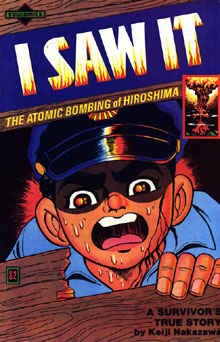
It was also a fun event for the folks I met there, one of whom was Leonard Rifas. Mr. Rifas was known to me by reputation; he teaches at a local community college and developed one of the first classes in comics (scroll down to HUM 270) in the region. We had never met, so it was good to make contact. I found out that Mr. Rifas was also the editor and publisher (at Educomics) of I Saw It, Barefoot Gen, and Gen of Hiroshima, which comprise Keiji Nkazawa's memoir of the atomic bombing of Japan. These books appeared about the same time as Maus but are overlooked. Gen of Hiroshima was one of the first graphic novels I bought for the library way back when, and Leonard was nice enough to give me a copy of I Saw It. Good stuff, the book and the evening both.


Tom Spurgeon started it as an audience response post, but Steve Flanagan turned it into a meme, so I'm chiming in with my "five good superheroes created since 1950 and not published by DC, Marvel or Image" in no particular order.

1. Captain Confederacy (Shetterly/SteelDragon) Pick any version you want, or even one of the other international heroes that inhabit Will Shetterly's alternate reality: they are all strong concepts and interesting characters. I raved about them some time ago.

2. NoMan (Wood/Tower) Again, just about any of the T.H.U.N.D.E.R. agents cold qualify, but the inherent loneliness and alienation of the character, buried deep in the sci-fi-spy trappings that surrounded him, is still fascinating. Wally Wood was doing better even work that he thought he was, I think.

3. Mr. A (Ditko/Witzend) As a pure, unrefined actualization of a creator's vision, it would be hard to top Steve Ditko's Objectivist Avenger. Although far from Ditko's best work artistically or narratively, the small ouvre is both challenging and compelling.

4. S'amm S'mmith, the Martian Manhandler (Friedrich/Charlton) A member of the Bestest League of America appearing in the Blooperman spoof strip, I have to give this guy props just for the best parody name ever and for being an antidote to the current Angry Broccoli Man characterization of the original. (Anybody have a scan of this strip?)

5. Jack Staff (Grist/Dancing Elephant) I think this is my only repeat from anyone else's list (Steve's was one) but that's okay: he only represents everything that should be good about superheroes and superhero comics today. But I've gone on about that before, twice.

ENO TAERG BPT!

A book and ten reasons to love it:


JLA: Zatanna's Search
DC Comics: 2004
Written by Gardner Fox (with an additional story by Gerry Conway); art by Murphy Anderson, Bob Kane, Joe Giella, Gil Kane, Sid Greene, Carmine Infantino, Mike Sekowsky, Romeo Tanghal, and Vince Colletta

1. While the claim that this saga is the first major crossover event in comics is overstated (even without researching it, I would say that the Spy Smasher/Captain Midnight and Sub-Mariner/Human Torch meetings from the Golden Age qualify), it is clearly of historical importance. This book collects six stories from five different comic titles published over two and a half years, which taken together all form one narrative. Gardner Fox, that stalwart of the Silver Age, wrote all of the stories with his usual puzzle-solution structure; each teams Zatanna, the backwards-talking magician, with various heroes. While each story works as a done-in-one for the individual heroes, each is but one chapter in Zatanna's quest to find her missing father. The denouement comes, of course, in a JLA story featuring all the heroes Zatanna has previously met in her search. Such specific, tight, cross-story continuity was almost unheard of at DC in the mid-sixties. (And now that I think of it, this tale seems to foreshadow the wandering of Steve Engleheart's Mantis/Willow/Lorelei through various strips (and publishers) some years later.)

2. The introduction is by Steven Utley. He hasn't written an earth-shaking intro or anything, but it is nice to hear from a knowledgeable commentator who isn't one of the usual suspects. Besides, any collaborator of Howard Waldrop's is okay with me.

3. The TPB includes extras. Besides the six main stories, there is a cover gallery and a sort-of prequel published in 1980.

4. The stories have narration captions, thought balloons, and editorial notes. I like to see comics that are self-consciously comics; too many contemporary books seem to be movies-in-disguise, and I think creators are often overlooking the textual component of comics in an often misguided attempt to be cinematic.

5. If you are of a certain age (like me) this collection will transport you to a former time and place. You may have read all of these comics upon their original publication (I think I did, even the lame Batman/Outsider story); you may only recall two or three of them and have never known the full narrative. In either case, you will feel once again like you have scraped together a whole quarter for an eighty-page giant, and lose yourself in simple wonder again.

6. The art. Here's Zatanna and Hawkman by Murphy Anderson:


7. The art. Here's Zatanna by Gil Kane and Sid Greene:


(This team did the Green Lantern story, too.)

8. The art. Here's Zatanna by Carmine Infantino:


9. The art. Here's Zatanna and the JLA by my man Big Mike Sekowsky and the ubiquitous Sid Greene:


10. The cover has got go-go checks across the top! How can you resist?!

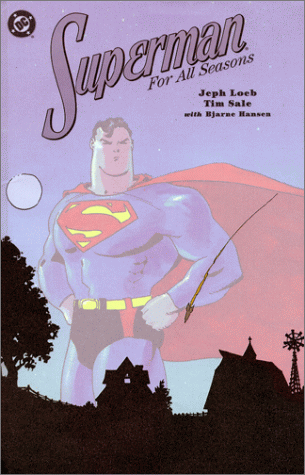
Lat week, I talked about picking up Superman For All Seasons at the library, and being glad that I could get to read it without having to purchase it. I also borrowed this book on that same visit, but this one I think I will eventually buy for the bookshelf. I had missed this when it was first published, and would likely not have tripped over it except for the library.


Super-stuff

So, the other day I was off at the local library and decided to check out their graphic novel collection*. I haven't made a habit of regularly getting my comics from the library, but I think I will start - the collection is getting broader and the practice would be a nice corollary to my "wait for the trades" policy.

One book I borrowed from the library was Jeph Loeb and Tim Sale's Superman For All Seasons (DC Comics: 1998). This was a book I had seen in its original single-issue format and decided to wait for the collection; once the TPB came out, I looked at it a few times but never picked it up. Having a chance to read it at my leisure for free was all it took!

In the end, I'm glad I waited and waited, because I don't think I would have been satisfied with this purchase. I know there has been a lot of praise heaped upon this work, but I didn't think it was all that successful a piece.

I think I got what Loeb was trying to do - the whole Norman Rockwellization of Kal-El, if you will - and I can appreciate where that approach comes from - showing that Superman might have started as an alien, but has become a naturalized American, through and through. I just think the presentation was a bit heavy-handed, and inaccurate, to boot.

Clark Kent's homespun beginnings and influences - delivered mostly through Pa Kent's ruminations and amplified by the LLs' caption boxes - are just too saccharine and simplistic; I can't imagine getting the moral grounding to deal with near-infinite power from such homely truisms and conventional wisdom. "We each do what we're able to, Clark, some less, some more," Pastor Lindquist tells him. Is that empty homily supposed to help a superman make decisions?

It also bothered me that the Kents seemed so middle-of-the-road; I liked the early, left-leaning, fatcat-bashing Superman of the Golden Age, and always imagined Pa Kent as an old Wobblie with some shady anarchist connections from his early days, who moved to Kansas from West Virginia after the Matewan Massacre or something. And maybe Ma was a suffragette and a socialist. I mean, Clark had to have gotten those political leanings from somewhere. I didn't see any populist or progressive attitudes on display in Smallville.

Sale's art follows along with the story themes very closely - which is to say, a bit over-the-top. I liked the cartoony style and the bulky Clark; that was cool. The Kents teetered on the edge of gnomish, however, and the art direction was all over the map: the faux-forties in Smallville and retro-future in Metropolis I can see, but the seventies Luthor-suits, the oh-so-nineties Toxin (puh-lease), and the contemporary (ballcap-backwards) kid seemed jarringly out-of-place as a result.

Which is not to say Sale didn't do some great stuff anyway and try to develop a consistent visual vocabulary: for example, the composition in this panel, repeated several times, was a great artistic device linking the boy from Smallville to the man in Metropolis.


In any case, the book wasn't bad, I just didn't think it was great. It was certainly several orders of magnitude better then the execrable World of Metropolis, which it resembles structurally.

I'm glad the library had it.

*Way back in the dark ages of 1994 or so, I was instrumental in developing the first specific comics collection in the Seattle Public Library. My branch managing librarian got an allocation for a special collection and let me spend it on comics: I remember buying Maus and Barefoot Gen, but can't recall what the rest of that initial collection comprised.

Staff, Jack and dis-types


Jack Staff, Vol. 2: Soldiers
By Paul Grist and Phil Elliot
Image Comics: 2004


I read and reviewed Paul Grist's first Jack Staff collection a few weeks ago, so it's probably not surprising that I have devoured the second volume. Soldiers is a bit of a change from Everything Used to be Black and White in a specific way: it is in color. I don't want to say the color is bad, because Phil Elliott did a great job doing whatever all the things are that colorists actually do in this digital age, and the book looks great, but after reading a collection of twelve issues in black and white, it was a bit jarring, and Grist's illustrations are so strong they don't seem to need colors anyway.

The story itself continues to backfill Jack's history, filling us in on why (at the start of the first volume) he had been absent from heroing for twenty years. It features the now-familiar cast of reporters, cops, agents, robots, and supervillains, most of whom would be as comfortable on an ITC television series as in a comic book. Grist continues to develop his mastery of the multi-layered narrative and provides us with another ripping yarn, fraught with portent and hidden depth, but it is on three of those supporting characters whom I would like to focus today.

Becky Burdock, Vampire Reporter


A modern Nellie Bly in Annie Hall's castoffs, Becky is driven, dedicated, and competent; young, but no ingenue, and a decidedly non-nosferatic vampire, she is a professional whose agenda sometimes parallels and sometimes conflicts with Jack's. There might be the slimmest hints of the beginnings of some sort of romantic entanglement in their relationship, but mostly they find themselves circumstantial allies trying to survive the same catastrophes.


I have noticed that twice so far, Jack has responded to requests for assistance from Becky by saying he was too busy to help; Becky has gotten herself out of the situation anyway: so much for the damsel in distress trope. Jack had better be careful, or she'll stop letting him tag along on her adventures.

Helen Morgan, Q Branch


Morgan is the enigmatic lead agent of Q Branch, an X-Files-like unit that kicks a bit more ass than Fox and Scully ever did. She puts me in mind of what the Phantom Stranger might be like if he joined the civil service; mysterious and powerful, but in a mundane and quotidian way, a George Smiley of the paranormal. Her quiet presence drives and directs the efforts of the splashier coppers and super-cops, but she's not at all hesitant to get down and dirty when she needs to.

How tough is she? Well, in Soldiers, Detective Inspector Maveryk, consumed by a mysterious rage effect plaguing the community, surprises her and beats her to death with his police baton in an interrogation room, and then drunkenly awaits his discovery and arrest in the squad room. Here's the upshot:


Now that's tough - not a word, not even a look. Don't mess with Helen Morgan.

Liz Stewart, Special Military Intelligence, Lethal Executive


Were Bruce Willis a woman, he might be able to play Commander Stewart, if he could reign in his soft side. This hard-as-gravel military operative is strong, single-minded, and smart. Whether facing up to an out-of-control superior officer or fighting her way through a town of enraged killers, she is in control, and puts the "no" in no-nonsense. Here she is mixing it up with The Claw, a Q agent who is invisible except for his electric hand:


Stewart was introduced only this volume, but I am looking forward to seeing more of her - as long as she's not after me.

What do these three characters have in common? Besides being cool, they are all women. I know I recently read a post somewhere that argued against praising writers for writing strong female characters because, after all, that's just what they ought to be doing, and we shouldn't praise people for merely doing the right thing. I find myself forced to disagree with this position; sometimes doing what we should do, in the face of peer pressure or tradition or temptation or even just ease and inertia, is noteworthy, at least to the degree that such attention would encourage further good work. It is in that spirit that I single out Paul Grist for this particular praise.

Becky Burdock, Helen Morgan, and Liz Stewart are all fascinating and colorful characters and could have - and likely would have - been written as typical male characters by a lesser talent; I call this progress, of a sort. Each of them is a woman, but none is The Woman: each has a purpose, role, and a nature beyond her gender alone.

Yet, we get the sense that each one is fully-fleshed-out character whose gender is part and parcel of her makeup, not just a random characteristic chosen from a character-generation program for an RPG, or a checkmark on a diversity quota list. There is no T&A in this book, but if women are your fancy, I defy you to read this without falling a little bit in love with at least one of these characters, because they are all real and wonderful.

And that, my friends, is worthy of note.

Bonus Strong Female Lead: Patti Smith


This is the cover of the "What's Happening" section of the Seattle Post-Intelligencer, one of those inserts that come out on Fridays with arts and events calendars. The cover story features Patti Smith, who was having a show in town, and the story applauded her neverending battle against the commercialization of rock.

As soon as I looked at the cover, I got it, but to be test it out, I showed it to my partner, a non-comics-reading female person, and asked her what she saw. She almost immediately said "She's supposed to be Wonder Woman." I asked what made Patti Smith into Wonder Woman; she pointed at the tiara, and then noticed the wristbands as well.

Now, if that's not iconic status, I don't know what is. I don't care what anyone says, for pop culture reasons alone, Wonder Woman is, and always will be,one of the big three.

Now, if they could only get her comic right...

Now I know Jack

Before I begin to go on about Jack Staff, I want to recount this anecdote: I was in my LCS and my partner, a female-type person, met me there before we went off on a mutual errand. As she scanned the titles on the shelves, she saw this issue of Green Lantern. Her response to it was to point and say "Ah, boobies!" We talked about it later and it turned out that while she wasn't particularly offended (although she did find the female figure somewhat objectified), she presumed that the breasts were supposed to be the focal point of the picture. Let me say that again: an intelligent woman (a poet and artist), more or less unfamiliar with the conventions and tropes of superhero comics, thought that a cover containing a (to my eye) fairly typical representation of a female character indicated that the story was somehow about sexual themes, not heroism or adventure or villainy or conflict. I would say that this was food for thought, but really it's just another example of an issue that has been well-proven but which is still not accepted as a "real" issue by significant portions of comics readership (and creatorship). Le sigh.


Well, since I don't read mainstream superhero comics much anymore (because of that very kind of stuff), what I left the shop with was Jack Staff Volume 1: Everything Used to Be Black and White by Paul Grist


This was more like it. The volume collects the first twelve issues of Grist's British take on the superhero genre, which he maintains is mostly unexplored in British comics. I found this approach to be refreshingly rich; although Jack Staff is clearly a superhero figure, he inhabits a world that is both quirkier and more familiar than most comics worlds, making him not so much a unique figure as someone is just one more standard deviation off the mean than most people.

From the get-go, the book is a clear bargain that confirms my choice to "wait for the trades." For a double sawbuck, I got almost 350 pages of story; if I had spent the same money for five floppies, I would only have a had a third of that. Granted, this collection is in black and white, but since that's how the stories were originally presented, there's no content lost, and Grist is a master of the black and white idiom anyway.

In addition to the sheer number of pages, Grist just packs the book, first with characters. In addition to Jack, we have Becky Burdock, Girl Reporter (who becomes Vampire Reporter in short order); an hommage to The Invaders; a robot man; an old-fashioned copper (who could have been the inspiration for Jerry Lynch in Intermission); agents of a special branch, supernatural-type; agents of a special branch, superspy-type; in-story parodies of Neil Gaiman and Alan Moore; a Victorian escapologist; a retired super-thief; and many more.

The characters propel a narrative that is complex and layered, and Grist relates it in an overlapping, non-linear style that requires full engagement on the part of the reader but which never quite crosses the line into confusion or obscurity. There are no real sub-plots; there are multiple plots playing themselves out simultaneously. One sequence in particular, involving the intersection of the main protagonists at bank robbery, pulls off the shifting between multiple points of view exceptionally well.

Grist's layouts are as dynamic as his narrative structure; he uses lots of panels per page and some innovative sequences. Sometimes they work and sometimes they don't, but they are always interesting. Check out this sequence in which Burdock finds herself an unlikely ally; see how it stacks up using Skipper Pickle's methodology for examining page composition.


There was so much to like in this collection. Many of the characters are take-offs from established television or comics characters. I knew some of them and got a sense of some others, but the references never detract from the story and anyone could have a great time without "getting" any of them. Grist re-imagines the familiar through his working-class British lens and makes everything fresh for all readers.


Another thing that every reader will come away with is the sense that Grist can write strong female characters. There is no T&A in the book, no damsel in distress, no woman-in-peril, no "the girl." The lead agent for Q, the supernatural cops, is the tough-as-nails Helen Morgan, a sort of Stephen Strange in a green trench coat. Becky Burdock is another great example: her "rescue" by the affable vampire-hunter in the sequence above presents him as the romantic naif that he is; Becky may appreciate assistance but doesn't need rescuing. She is tougher and smarter than Lois Lane, even if she is stuck at a tabloid.


I would compare this shot with what passes for images of "realistic" women in mainstream comics, but I don't have it in me to heave another sigh.

Not too long ago, I expressed frustration at trying to find "robust, intricate stories, set firmly in the [superhero] genre, that engage my imagination, intellect, and emotions." I was looking for stories in which "maturity" meant emotional complexity, not gratuitous sex; in which the action didn't necessarily have to involve dismemberment and torture to be "serious"; and in which the characters act in ways that human beings that inhabit the actual world would, no matter how fantastical their circumstances. Jack Staff gives me all that, and I can't wait for the next installment.

Awesome anniversary edition


Before there were company-wide, universe-spanning crossover-events That Would Change Everything Forever ™, some of the biggest occasions in comics were anniversary issues like the one pictured above. Showcase #100, published by DC in May 1978, was one such special issue. The story included every character every to be featured in the title, including Fireman Farrell from issue #1, before the title became a super-hero tryout book. If I recall correctly, there was some time-and-space-continuum-warping disaster that needed the response of all the heroes, but the ultimate savers-of-the-day were Lois Lane and Angel O’Day (from Angel and the Ape), with a little last-minute assist from the Phantom Stranger.

Well, I can't promise a visit from every character who has ever been featured in this blog, but this marks my 100th post, so I thought I would make it at least super-sized, if not super-special.


Movie review:
Fantastic Four: The Rise of the Silver Surfer


(minor spoilers)

I was one of the few people who actually enjoyed the first FF movie, as demonstrably bad as it was, so I went into the sequel both predisposed to like it and with low expectations. I was neither disappointed or surprised: I liked it, and it wasn’t very good.

It seems like the FF franchise is like the classic C-student in one of my classes. I don't dislike him: he works consistently, shows up most of the time, and turns in assignments regularly. It’s just that his work is always average: uninspired, unimaginative, and unexceptional; he tries hard enough, but just doesn't have what it takes to really shine, at least not in class. Similarly, the FF movies go through the motions, have all the right elements, and project a positive attitude; they just never get past being merely okay and enter the great (or even good) category.

Some pluses in this film: Reed Richards is portrayed as both a genius and a leader; Johnny Storm acts both annoying and admirably; The Silver Surfer is cool in both body and voice; the Fantasticar by Dodge is cute; we get to see Dr. Doom on the silver surfboard; there are decent action sequences.

Some specific minuses: Sue Storm is portrayed not as a smart scientist but as a flighty girl preoccupied with a “perfect wedding” and a “normal marriage”; Ben Grimm wears oversized clothes as the Thing, detracting from his inhuman appearance; the Galactus appearance is a cheat; the crappy technobabble is annoying; there's pedestrian acting all around and uninspired direction; and there's way too much Stan Lee (remember, a little goes a long way).

Overall, I enjoyed in the same way I would enjoy reading an old 80-page giant: mostly in spite of itself.


Graphic Book Review:
Halo and Sprocket, Volume 1: Welcome to Humanity


I mentioned this book in one of my earliest posts, but it has taken me this long to find a copy and read it all the way through. A sincere word of advice to you: don't be the dolt that I was. Run, don't walk, to your LCS, or jump online and order this book right now. It is one of the most charming trade paperbacks you’ll encounter.

Halo and Sprocket are, respectively, an angel and a robot who live with a young woman named Katie. Halo is helping Sprocket learn about people and develop as an individual, but is often distant from humanity himself and needs Katie’s perspective. No back story is given as to how this arrangement came about; it just is.

The circumstances lead to hijinx, of course: wordplay, misunderstandings, and even slapstick punctuate the lessons and inquiries. Kerry Callen builds a world that is both real and whimsical, with characters that are round and rich in situations that are totally plausible while being completely unrealistic.

The book is light-hearted and humorous, but Callen reveals from time to time that there is a real wisdom and search for truth going on in the strip. Here’s Sprocket responding to Katie’s demonstration of the hoary glass-half-full question:


And here’s Halo coming upon the ancient Egypt display at the natural history museum:


I am so going to work this text into my critical thinking lessons.

I wish I had acquired this book a year ago, because I would now be on my twelfth read instead of my second. Go get it right away.

Halo and Sprocket, Volume 1: Welcome to Humanity by Kerry Callen. Published by Amaze Ink (a division of Slave Labor Graphics) in 2002 and 2003. Collects issues #1 through #4 of Halo and Sprocket and includes additional material.


Graphic Book Review:
The Plain Janes


I had high hopes for this book. I was interested in the whole Minx line from DC and wanted it to be good: as I have said before, I think the more viable diversity there is available in comics, the better off the form will be. This particular offering, a high school drama, appealed to me the most, and I went into it wanting to like it. Unfortunately, it let me down.

Cecil Castellucci is an apparently big-name indie-punk author who was brought over from “real books” to write this graphic novel; Jim Rugg provides the art. Unfortunately, Castellucci’s story disappoints, and I don’t think it’s because of the transition from prose to comics. The book seems to work on a formal level; there’s not a lot of experimental or exciting graphic work going on, but it’s good straightforward story telling, like a Ron Howard movie as opposed to a Brian DePalma film. It's just that the story never seems to click together. The characters’ motivations seem unclear or underdeveloped, the plot developments often implausible or off-key, and the narrative arc stumbling and ultimately unsatisfying. There are a number of important themes in the book, but they never cohered for me into any unified message.

That said, I gave the book to my significant other, who is both a female person and an artist, and she loved it. And she isn't a comic reader, so maybe the book did meet its goals with others, and it's just me who doesn't get it.

In any event, I still applaud Minx and I will give another of their titles a try.

The Plain Janes by Cecil Castellucci and Jim Rugg. Published by DC Comics in 2007.


A meme

I usually don't respond to this kind of meme, but I was tagged by RAB at Estoreal, and my esteem for him is so high, and my pleasure at being seated at the same table with The Fortress Keeper is so great, that I have succumbed. Here it is:

I have to post these rules before I give you the facts.

Each player starts with eight random facts/habits about themselves.

People who are tagged need to write their own blog about their eight things and post these rules.

At the end of your blog, you need to choose eight people to get tagged and list their names.

Don’t forget to leave them a comment telling them they’re tagged, and to read your blog.


1. I don't own a pair of jeans and haven't in more than ten years.

2. I have never broken a bone*, had a stitch, or spent a night in the hospital.

3. It took just shy of 27 years to go from my first day of college to my being awarded a bachelor’s degree. On the other hand, it took me just eleven months to obtain my master’s.

4. I had a hamster named Henry. When I was 42.

5. I once drove from NYC to Chicago with my girlfriend and her friend and her friend’s boyfriend in a Buick Estate Wagon. We dropped him off at the University of Chicago, had some pizza, and drove back home.

6. I was a police offer for almost six years and in all that time I managed to avoid ever having to help carry a dead body. It became sort of a game with me; I would watch the M.E. out of the corner of my eye and make sure that I was otherwise occupied when he would look around for a hand wrangling the corpse into the van.

7. When Frank Gorshin appeared in a commercial for the Batman TV show, another neighborhood kid challenged me to name the character he was playing. I bluffed and called him “Mr. Question Mark” as if I knew what I was talking about. I was wrong, of course; the kid knew it was The Riddler. I had no idea who the character was.

8. When I was in high school and we were applying to colleges, I wrote to the University of Iceland in Reykjavik asking how I could apply to their school. I think we had just been reading the Elder Edda or something. I got back a very nice letter that basically told me to get lost. It made it clear that they only infrequently accepted foreign students, and that I should attend a U.S. college for two years first, and that if eventually accepted I would take only Icelandic History and Icelandic language instruction for the first year, and that all further classes would be taught in Icelandic. I didn't apply. Thirty years later I visited Reykjavik and went to the University. Three-quarters of the books in the bookstore were in English.

*I might have broken a pinky-toe bone once, but that doesn’t really count.

Tagged: Marionette, Ami Anglewings, Irate Canadian Lass, Capt. Infinity, Bully, Katherine, Steve, Skipper Pickle.


Thanks for a great ride through the interweblogosphere. This has been a voyage of discovery for me, and the best thing I have discovered so far is a community of bloggers who care about comics and can speak about them articulately but who at the end of the day don't take all this sturm and drang too, too seriously. After all, to paraphrase a little stuffed bull, "comics blogging should be fun!"

Belgian treat

No, it's neither chocolate nor beer. A buddy of mine went over to Brussels for a week with his sweetie, and brought something back for me that I had never seen before:


Luhca Libre #1, Les Humanoides Associes SAS

Lucha Libre is a French-language comic set in East L.A. It stars (or at least this premiere issued starred) The Luchadores Five: El Gladiator (a self-proclaimed reincarnation of an Aztec mummy) Dr. Pantera (the short, fat one), Diablo Loco (a big, cigar-chomping guy), Red Demon (who wears a suit and chain-smokes cigarettes), and King Karateca (who appears to be a martial-arts type dude). For those not dialed in to the genre, lucha libre is Mexican freestyle wrestling, and luchadores are masked wrestlers whose personae in real life traditionally blur the lines between athletes, celebrities, actors, and superheroes. This quintet doesn't seem to command as much respect as El Santo or Mil Mascaras, however; they hang out in run-down apartments, drive beater cars, and seemed to be mocked by a lot of the background characters, such as winos. There adventures seem every bit as wacky, though.

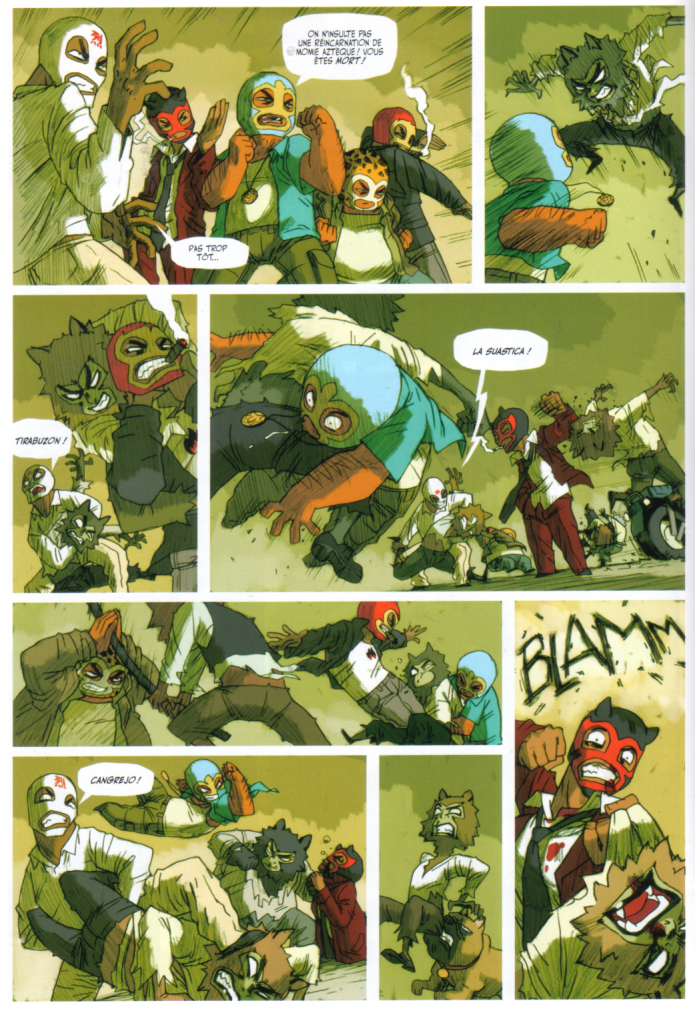
It was hard for me to follow the details of the story, since I have little French, but the group appears to be on some trivial mission involving Dr. Pantera's car when they cross paths with a gang of motorcycle-riding werewolves. Negotiations break down and El Gladiator, who seems to be the leader, throws down with the lycanthropes:


Although the boys seem to be winning, the fight is cut off before a conclusive finish by a shotgun-wielding local in a John Deere cap, who essentially tells everyone to get off his lawn, and the combatants retire from the field of battle.

As the luchadores regroup, we join up with two aliens who are stuck in traffic on the I-5 at the Pasadena Freeway; they either release or merely observe - I couldn't tell for sure - a dinosaur, which we see walking in traffic.

The luchadores meet up with and - I think - join forces with Les Formidables, a group of French ninjas, on a mission related to the aliens, but not after the obligatory fight scene:


Meanwhile, the aliens have been abducted by tiki-warriors,


and the dinosaur is getting the worst of an encounter with some street kids:


The story seems to be continued; it ends with the reveal that the leader of the tiki-warriors is an Elvis impersonator.

Y'know, I said I had little French, but I'm not so sure how much sense this would all make if I was Charles De-fracking-Gaulle. It doesn't matter, though; the pictures are cool, the action is sweet, and there's a frenetic energy to the whole thing that is infectious and appealing.

The book rounds out with some text pieces (heh, big help) and a few shorts, including a couple with Profesor Furia (another, humorous (?) luchadore) and some meet-the-characters bits (El Gladiator and I are the same height: 1 m 68 et demi), as well as a tease for the next issues, promising Tequila, a hulking luchadore with a horned mask, and El Panda, who appears to be a Chinese Communist luchadore.

I had a devil of a time tracking down any English-language info about this series on the internets. Here's the page from the publishers site in French; and these guys apparently make figurines of the characters (in English).

My buddy's sweetie is still in Brussels for a while; maybe I can get her to bring back the next issues.

Trade winds

So, I was in the LCS a few days ago (not on Free Comic Book Day, darn it - I had commitments for all of Saturday!) and I picked up a couple of trade paperbacks. Overall, I wound up pleased; here's a response to just one of my purchases.


Shadowpact: The Pentacle Plot

Pal Bully would say "This comic is fun!" I had originally picked up Shadowpact #1 as a floppy; I thought it was okay, but didn't think I wanted to buy it every month. I happened to lay eyes on this trade; it was only fifteen bucks for seven issues collected (why is #4 missing?) with a cover gallery and no ads, so I took a flyer on it. And it was worth it.

S:TPP is no graphic novel. The narrative arc doesn't have the cohesion for this to be considered more than a collection of related stories; the last episode in particular strays far from the unifying theme and there is a teaser at the end of the penultimate chapter that never gets its proper reveal. These quibbles aside, there's some rollicking good adventure in here: Bill Willingham can put a story together competently, that's for sure. There's a lot of humor, and the gore-quotient was well within my range. Even though I don't know much about the current incarnations of these characters, I felt I had a good sense of their personalities, and the team feeling certainly came across well.

The art was a bit uneven; the art team did not repeat once across the seven stories. Luckily, most of the styles were pretty complementary, so as pencillers and inkers changed, the transitions weren't too jarring. The only exception was Tom Derenick, whose pencils were too super-heroey, bordering on Liefieldish, for my tastes. (In every other issue, Jim Rook looks like a regular guy; in Derenick's, he was all buff matinée idol.)

So, if nothing else, my "wait-for-the-trade" policy was affirmed: the TPB felt substantial, and the price/enjoyment ratio was dead on.

:::::::::::::::::::::::::::::::::::::::::::::::::::::::::::::::::::::::::::::::::::::::::::::::::::::

Well, I did fall of the wagon and get a floppy: 52 # 52. I had been reading about the return of the multiverse on the blogs, and I wanted to see it for myself. So, what did I see? A big ol' mutated Mr. Mind slurps up reality, creating parallel worlds. Hokay, whatever.

Earth-17: Atomic Knights, yay! Giant dalmatians replaced by big spotted scary pointy beasts, boo!

Earth-3: Gets a Martian Manhunter! And the fast guy gets a belly-shirt! Um, yeah.

Earth-10: Old school Freedom Fighters! And Phantom Girl's breasts look human!

Earth-50: Is this Wildstorm or something?

Earth-5: Cheese! (Big and red!)

Earth-22: Ooh, grim.

Earth-2: That doesn't look like the JSA I know. Am I missing something important, or is this going to be an alternate JSA, and the JSAers are going to stay in the "main" universe as well? (And is that an alternate-reality spelling of "innocence" or does the Gotham Gazette not have proofreaders?)

Earth-4: Old school Charlton! Cool!

So, maybe there's room for some fun in there. But I'll still be waiting for the trades, I think.

PS: I did think the scene with Ted Kord was pretty touching, and deftly handled.

No April's Fools

So I was in a different LCS than usual the other day (I am lucky to have at least three comic shops within walking distance and another not too much further) and my eye fell on a graphic novel that I had never seen before:

jar
Jar of Fools: A Picture Story
by Jason Lutes; Drawn & Quarterly, 2003


I picked it up and flipped though the pages; I liked the art and had an impulse to buy it.

Then I glanced at the prose introduction and saw the first sentence: "Okay, so five or six years ago, I impulsively picked up Jason Lutes' Jar of Fools in a local Seattle comic book store, flipped though the pages, liked the art, bought it for a few bucks, and took it home." That synchronicity was enough to persuade me; any shadows of hesitation were dispelled when I saw that the introduction had been written by Sherman Alexie.

I did buy it and take it home (for more than a few bucks, though). I occasionally like to read a book or see a movie about which I know almost nothing; I had gotten lucky with my last "blind" graphic novel, Daisy Kutter, and the serendipity came though again. Jar of Fools is an excellent book that tells a complex story in a compelling manner.

Lutes chronicles a brief period in which several lives intersect: an alcoholic stage magician, his estranged girlfriend, his rapidly-becoming-senile mentor, and a small-time con-man and his daughter; in addition, there are "appearances" by the magician's dead, escape-artist brother. All of the characters have to come to grips with the gap that exists between what they want and what they can get and learn to do the best with what they have.

A story such as this one, concerned with desperation, depression, and struggle, could easily descend into bathos, but Lutes fills his characters with so much humanity and his plot with so much wit, humor, and detail that we are engaged, captivated, and, in the end, just a little bit hopeful.

What impressed me the most was Lutes's command of graphic storytelling. Working in a ligne claire style (or close enough to it to make no nevermind), Lutes masterfully uses all the techniques and elements particular to comics to bring his story to life: the page layouts and panel transitions build the narrative as effectively as the expressions and body language, and Lutes is not afraid to use emanata and graphic balloons. In short, Lutes knows that he's creating a comic, not an illustrated story or a static movie, and that's the understanding that moves a creator into Eisner territory. That he has fashioned what would be a wonderful tale in any medium makes it so much better.

joke

Jar of Fools is simply a great book. I've read it twice now already, and I'm sure there are plenty more reads left in it.