Showing posts with label comics commentary. Show all posts

Comics, comics, everywhere...

with esteem and respect to Bruce Eric Kaplan

I have cited this cartoon before, because I think it sums up the mainstreaming of comics that we seem to have been experiencing over the past few years. We can parse out the details, but there's no denying that folks are talking about comics out in the open, without apology, with more frequency than ever before. This situation was driven home to me over the past few days.

First off, I got a phone message from a pal telling me that a local AM talkradio host was going to be interviewing Neal Adams. I tuned in and for a solid hour Adams talked about the reinvention of Batman in the sixties after the television show and other topics that wouldn't have been out of place on any comics blog. Check it out: July 15, 2:00pm.

I grant that that interview might have been sold because of the Dark Knight movie, and that the situation in general has been helped by so many comic book adaptations or comics-inspired films being released this summer, but c'mon: who would have imagined that a regular essayist on NPR would contribute a piece examining in detail the DC fan/Marvel fan divide, under any circumstances? Yet this is what I heard the very next day on Morning Edition, in a piece by John Ridley.

The next day, Steve Scher, the host of Weekday, a local program on the Seattle NPR affiliate, devoted a whole hour of his show to comic books, speaking with Mike Mignola and Douglas Wolk, among others. I guess this shouldn't have surprised me so much, since Scher spent a whole hour interviewing David Hajdu a few months ago, when Ten-Cent Plague came out, and constantly surprised the author with his depth of understanding of the subject.

Out of curiosity, I did a search on the NPR site tonight, and found that this afternoon I missed an All Things Considered report on international comics and that a few days ago Day to Day used the Batman movie opening as a springboard to do a fairly thorough examination of the evolution of The Joker over the years. That's all in addition to pieces on Dark Knight itself.

To top it off, I stopped by the library this week to talk to another pal, and she gave me a copy of the SPL annual report: they got Ellen Forney to produce it in "graphic novel" format, which is to say it uses some specific elements and the general aesthetic of comics to present the material. Here's the cover and a sample page:


So, while I don't think that we'll be seeing folks on the beach reading comics a regularly as paperbacks, or that graphic novels will replace newspapers as the commuter's reading material of choice, it seems pretty clear that the door to the general culture is opening wider and a little bit of light is being shed onto the shadowy world of comics geekdom.

Another excursion into definition

Take a look at this little prose piece:

The proud Kuleeah was furious because Tarzan had made sport of her. Now she dashed toward him, determined to redeem her pride with his blood. She aimed a murderous blow at the head of unarmed ape-man. Again, Tarzan dodged, whirled, seized her, and lifted her high above his head. There he held her, kicking and squirming, while her comrades hurled gleeful taunts.

Though they laughed at Kuleeah's plight, they were impressed by the mighty Tarzan. “He can be my husband, though he conquer me and rule my hut,” cried one. This was heresy among the Amazons, who prided themselves on their dominance over men.


“I'll take him,” shouted another.

“No, he's mine,” insisted a third.

Soon, the tribe was in turmoil. As the warrior women fought amongst themselves, Tarzan set Kuleeah down. She ran away to get her bow and arrows. If she could not have him, no other would.

Then, suddenly, into this wild confusion burst a pack of hungry lions.

Although it does start in media res, this passage appears to be a pretty complete section of a narrative. Even from this excerpt, we can discern a lot about the characters and setting, and we can certainly follow the action. Is this a bit of a Burroughs book, or some fanfic, or what? Well, take a look at it in its original:

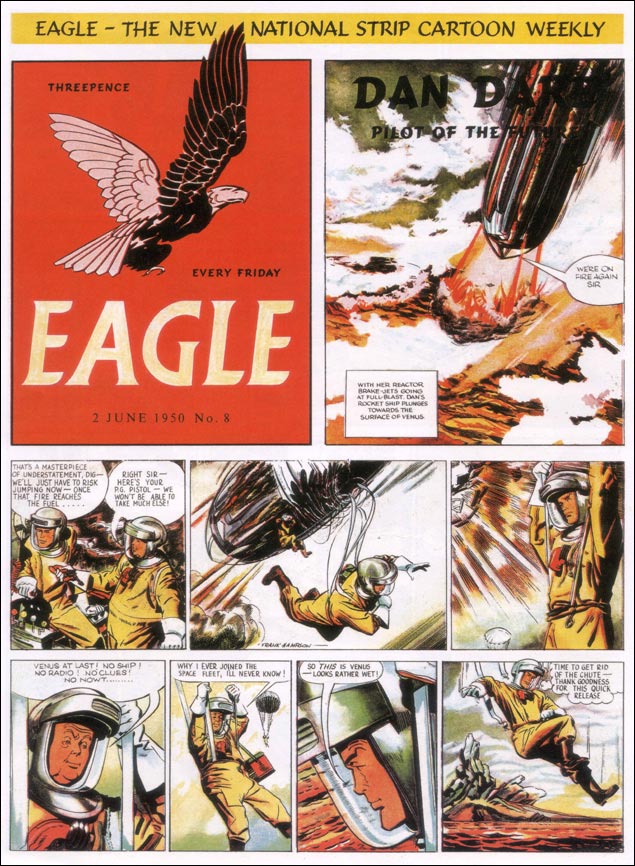
Click to embiggify

I ran across this Sunday strip at the ASIFA-Hollywood Animation Archive, which also has a wealth of comics and cartooning stuff.

I forget why I stumbled over it, but looking at this page immediately got me to thinking: there is no one, I think, who would exclude this page from a collection of comics, or comic strips, or sequential art, or graphic literature, or whatever phrase we want to use for all that funnybook stuff we like so much.

And yet, if we really look at the strip, there's no real fusion of word and image to make meaning or create communication. The text, as demonstrated above, can easily stand on its own and carry the entire narrative weight of the piece. The art, as exquisite as it is, really doesn't help to tell the story; it contains nothing new, no information that isn't already expressed by the text. The drawings certainly couldn't stand on their own and give us anywhere near the narrative detail that the text does. (For example, is there anything in panel four to indicate that the Amazons are "hurling gleeful taunts"?) To paraphrase Steve Lieber, the pictures may illustrate the story, but they aren't the story.

This seems to contradict what we expect from comics, that magical conjunction of words and pictures that creates something new, something that is neither merely prose nor art, but, well, comics.

We mist be missing something, but damned if I know what it is.

Maybe definition isn't that important after all.


This makes a dozen dozen posts on this blog: 144 entries in 915 days, about one a week. I know, that's pretty gross. I was looking for a significant milestone to quit on, and I thought this might be the one. But I don't think so now; there may be a few more things I want to say before that.

Interim linkage

Here are a few pieces from my recent bookmarks file:

The First Second feature Mentor's Corner has had some great essays on the structure and function of comics: Steven Seagle on Beginning-Middle-End and Calistra Brill on Time caught my attention in particular. These approaches provide a contrast to Neil Cohn's psycholinguistic investigations, which drive me crazy (but which I always read).

And speaking of alternate perspectives, it was interesting to find a fairly comprehensive overview of comics history on a marketing job search website.

A new journal, Graphoscope, should soon be joining the ongoing conversation, although I am always made a bit chary by the overuse of the word "criticism."

Just for fun, The Daily Batman is self-explanatory. I wonder how long it can go before it gets dull.

This weekend, I am passing up the Dalai Lama for Shary Flenniken - I'll tell you all about it.

So, what of this, if anything?

I was listening to NPR this morning and they had a short feature on Toby Barlow's new book, Sharp Teeth, a contemporary werewolf story written in free verse. I was only half-listening, and heard some references to Homer and whatnot, but then caught Barlow describing his book as a "graphic novel without pictures."

Hunh?

The NPR website lists the full quotation: "a ripping yarn with the extra words ripped away ... a graphic novel without the pictures, or a hard boiled novel that's been boiled down to a reduction sauce."

As Jude Law said in I Heart Huckabee's: wait, what does that even mean?

Isn't the essence of comics (and hence, graphic novels) something about the words and pictures working together to carry the narrative? Or just pictures, when there are no words? The excerpt I read looked more like an epic poem than anything anything else. Isn't poetry already distilled language, concentrated imagery, that conveys more with less? Does this metaphor really add any depth to the description that calling it poetry doesn't?

I don't think so. And I think there might be another reason behind its use. Googling the phrase only garners two hits: in a review of Richard Morgan's first novel, the science fiction story Altered Carbon and in a review of comics writer Warren Ellis's first prose book, the gonzo detective novel Crooked Little Vein. In addition, Barlow's book itself sports this blurb from Scott Smith: "If Ovid had been raised on a steady diet of Marvel Comics, Roger Corman, and MTV, he might have written something like Toby Barlow's Sharp Teeth." All this seems to indicate to me that something else is going on.

I think this metaphor is the highbrow marker for confusing form with genre when thinking or talking about comics. I don't think any of the three uses of this metaphor - even by the author himself - really indicates anything about the narrative structure or energy of the text; I think they're shorthand (or code) for saying something about the book's content and its relative value or merit, the same way an action film might be accused of having a "comic book plot."

I'm not sure how I feel about that, but I think it is what's happening.

Update - full disclosure:

Re-reading this post today, I realized I had only searched for "graphic novel without pictures." However, a search for "graphic novel without the pictures" (that ignores Sharp Teeth references) only nets a few more results:

In a parent's guide to children's books discussing Quantum Prophecy, described in brief as "Comic-book style superhero action; moral dilemmas, some driven by visions of the future."

In a review of An Alchemist with One Eye on Fire, a collection of poetry described as having "cartoon-like imagery."

In a customer review on Amazon of The Doomsday Brunette, a book about "genetically engineered superwomen."

In a customer review on B&N of The Traveler, in which the book's action sequences are compared to Kill Bill and V for Vendetta.

In a personal remembrance of having read Nine Princes in Amber by Roger Zelazny over thirty years before.

All of these seem to support my initial response.

There was one different take. In a blog review of The Plot to Save Socrates, the reviewer notes the author's spare writing and lack of descriptions, and uses the graphic novel metaphor as negative criticism.

So, is this a mostly useless little phrase, then?

Sad sack

So, I was sitting around in a local corporate coffeeshop, thinking about my missed post from last weekend and wondering if I wanted to have a strack, squared-away blog like The Fortress of Fortitude, with regular features and timely posts (and excellent writing), or a casual, whenever-the-spirit-moves-me blog, like Estoreal (with its excellent writing).

The spirit hasn't moved me much this week, that's for sure: Arthur C. Clarke died; he was a particular hero of mine, and his passing genuinely saddened me.

There were other, minor, more transitory sadnesses. I missed Comic Book Comics #1 when it came out, and my LCS still hasn't received their re-order.

I signed up to take a comics scripting class taught by Shary Flenniken at the Richard Hugo House, but there's only two of us registered (I think the other person is David Lasky) so it may not go.

And I went on the internets today to read my regular blogfeeds and found two bloggers, both of whom I enjoy reading, engaged in yet another comicsweblogosphere pissing match, the likes of which I think we have too much of already.

So, even though I am posting late, and even though I have not even made up my mind what this blog will be, all it is today is this:


Reading an English translation of a French semiotic analysis of the medium of comics can be fun

I haven't posted this weekend because serious affairs of RL have intervened.

Here is a quotation from my latest bedside book, The System of Comics by Thierry Groensteen, translated by Bart Beaty and Nick Nguyen (University Press of Mississippi: 2007).

At the end of the day, what makes comics a language that cannot be confused with any other is, on the one hand, the simultaneous mobilization of the entirety of codes (visual and discursive) that constitute it, and, at the same time, the fact that none of these codes probably belongs purely to it, consequently specifying themselves when they apply to particular "subjects of expression," which is the drawing.

And that's just in the introduction! Sheesh!

Regular posting will hopefully resume soon.

Two years down

Today is the last day of the second year that I have been blogging about comics.

I don't know where the time has gone: there has been so much from The Last Shortbox® that I haven't gotten to yet.

The first twelve issues of the wildly exuberant American Flagg.
The only twelve issues of the nearly incomprehensible Thriller.
The thirteen issues of the spectacularly bitter Haywire.

Keif Llama, Dalgoda, Evangeline.
Somerset Holmes.
The Desert Peach.
Gilgamesh II.

And yet, I have pretty much kept to my once-a-week publishing schedule.

I hit my hit-high over last summer, and viewership has been declining since. In the last few weeks, however, when posting has been especially spotty, the numbers are going back up. I can only conclude people like the blog better when I don't write new things. That sure makes it easy.

Along the way, I have been distracted by a dalliance with buying new comics, a commitment to waiting for the trades, and a habit of spending way too much time reading other people's blogs. (I have no idea how y'all make enough time for the (usually) entertaining posts I keep reading.)

I am seriously considering a PhD program with a focus on comics, if I ever get my teaching situation completely sorted out. If that plan pans out, who knows what will become of this place?

I am also seriously considering re-structuring all of my blogs into a different sort of web presence, so even without any life changes, this site might have (another) new name and a new address.

I guess this blog is of excruciatingly minor importance in the grand scheme of things, but it's worth continuing if it's still fun.

And it's still fun.

And as Captain Fear would say,

'Appy 'Olleedaize and a 'Appy Noo Jear!

By definition

One of the trickier intellectual challenges surrounding the study of comics is coming up with a definition of what "comics" is. On the one hand, creating a definition may be an empty enterprise; it could be said that poetry and prose get their share of analysis without anyone needing to pin down a universally accepted definition of either. On the other hand, as more scholarly study of comics is conducted and colleges and universities have to decide which programs will focus on the research and offer the classes and degree programs &c., a definition - particularly one that addresses the literary/artistic divide - might be useful.

Several candidates vie for our attention, Scott McCloud's "sequential art" proposition (after Eisner) and Robert Harvey's "juncture of word and image" articulation among the foremost. An argument is leveled against the first as being too broad (is the Bayeaux Tapestry really comics?) and the second as being too narrow (is there really no such thing as a wordless comic?). In the blogosphere, Eddie Campell has jumped in, and Patrick Lewandowski, each offering definitions that
to my mind are less rigorous and useful than idiosyncratic and interesting.

On the academic front, Greg Hayman and Henry John Pratt offered a comprehensive definition
("x is a comic iff x is a sequence of discrete, juxtaposed pictures that comprise a narrative, either in their own right or when combined with text") in their article "What Are Comics?" (which I haven't read); this definition was deconstructed by Aaron Meskin in his forthcoming article "Defining Comics?", in which he decides that the effort of definition is not worth the trouble.

And of course, there's Neil Cohn's Visual Language Theory, which, since it rises from a psycholinguistic frame rather than an aesthetic, will need a great deal more clinical research to establish its usefulness.

There are others I am not naming; my intent is not a full inventory but just a sketch of the terrain. I also offer no Unified Field Theory of my own; I confess that I am here to muddy the waters further. My impetus comes from perhaps an unusual source: children's literature.

I am not going to revisit the problematic "are children's picture books comics?" question; my question is, I think, deeper and applicable to more creators and creations in the comics world. The question has its origin in a mention to me last Friday by one of our campus librarians of this new acquisition:


The Invention of Hugo Cabret
by Brian Selznick

Scholastic Press: 2007


The librarian knows my interest in comics, and thought that I would be intrigued by the book. It tells the story of a resourceful orphan boy, living in a Paris train station, who gets involved in a series of adventures while he reconstructs a clockwork man that is somehow related to the pioneering filmmaker Georges Melies. She told me that the story was part prose, part illustration, and that the illustrations actually advance the story and are essential, not extra, to the overall narrative. She mentioned a dilemma inside Library-land: that everyone loves the book, but no one is sure whether it should be nominated for a Newberry Medal (for literature for children) or for a Caldecott Medal (for picture books). Of course, I was intrigued, checked the book out, and read it this weekend.

First of all, it's a great book; the story is compelling and real and the characters are engaging and complex, no matter how old you are.

It's also a hefty book: over 500 pages. I think it's aimed at the same crowd that reads about that Potter fellow.

But here's the rub: about 300 of those 500 pages are (imho) comics. There are no panels or word balloons in sight; these are wordless comics, to be sure, and each two-page spread is one image. There is, however, the definite control of the narrative through sequenced images, and the actualization of McCloud's "choices" - of moment, frame, and image - is very much in evidence.

The other pages? Straight prose.

How do these work together? Let me illustrate by example:

Page 205 ends this way:

Hugo stopped short and stared at her.
"I don't know anything about you," she said. "You know where I live, you know about my parents. If we're going to be friends, then I think I should know about you. Why won't you tell me?"

Suddenly, Hugo started to run.

"Hugo!" she yelled. "Stop! Wait for me!"


The next text appears on page 222, and begins:

Hugo helped Isabelle to her feet, but he couldn't stop staring at the key. Isabelle noticed and tucked it back in her dress.

Doesn't make much sense. does it? It does if you insert these panels in between:

1: Train station lobby, full of people; Hugo is to the left of the panel, running away from Isabelle, who is right center.
2: Closer image of Isabelle crashing into a hatted man; they both lose their balance.
3. Isabelle, looking scared, falls backwards; a small key on a chain around her neck swings out.

4. A close-up of Hugo's face, looking toward the right, shocked.

5. Near repeat of panel 1; this time, Hugo is running toward Isabelle, who is on the floor.

6. Close-up of Hugo's hand as he offers it to Isabelle.
7. Isabelle reaching up to take Hugo's hand; the key hangs around her neck.

8. Close-up of the key on its chain; it has a distinctive heart shape, and a clever reader may have seen the keyhole already!


Wow! What do we do with this? The whole book is like this: some sequences are presented as wordless comics and some as straight prose. If you just took the text bits, you would have an incoherent story; if you just took the illustrations, the result would be the same. It's not a comic book; it's a book-comic! I have to wonder why Selznick took this path, and what his creative processes were like: how did he choose which instances to illustrate and which to write?

The author is not much help in figuring out the work. On the official website, he says that the book is "
not exactly a novel, and it’s not quite a picture book, and it’s not really a graphic novel, or a flip book, or a movie, but a combination of all these things." Maybe it really is a new, hybrid form, but the illustrated sections are definitely comics in even a narrow sense of the term, employing the techniques that we commonly associate with the form.

So, the question: do we shelve it in the literature section or the art section or the graphic book section? Or does it matter?


Non-web resources:

McCloud, Scott.
Making Comics (Harper Collins: 2006)
McCloud, Scott.
Understanding Comics (Harper Collins: 1993)
Varnum, Robert and Christina T. Gibbons, eds.
The Language of Comics (University Press of Mississippi: 2001)

Trailer Reel/PSA/Clip Show

Well, I can quibble all I want about how late is late, and whether this post counts as last week’s or this week’s or next week’s, but the unavoidable fact is I missed a week. I think consistency is an important characteristic of a blog, and even though I set the bar for myself pretty darn low, it is irksome when I don't meet it. (On the other hand, RAB posts only sporadically on Estoreal, and I think he has one of the finest blogs going, so go figure.)

I think part of the problem is an identity issue (not to be confused with an Identity Crisis). I still haven’t decided what I really want to do here. I do know for sure what’s not on the list: I don’t want snark or irony or smug hipness (hip smugness?) to be what this blog is about. I think from the beginning , I wanted to stake out the territory articulated by our dear pal Squirrel Girl here:


At its best, this approach is fun; at its worst, it turns into wallowing in nostalgia and yelling at those kids to get off your lawn. (For some of the best, check out the Keeper in the Fortress of Fortitude.) There’s charm in looking back at old school features like Cap’s Hobby Shop


…and wondering what it says about how the audience for comics and their place in our broader popular culture have changed. (It's also just fun to wonder why they were called “Turkish Towels” and if anyone still calls them that and whether this cunning plan merely delays the dripping until the towels become saturated, but that’s a horse of a different color.)

Sometimes I worry about merely living in the past, however, and I want to talk about new and exciting comics, especially the ones that aren't trying to be The Sopranos in spandex. Things like the American launch of The Ninety-nine


… the Islamic-themed superhero adventure series (which has potential) from Teshkeel Comics. That would be fun to do, but I am so slow on the draw that most people will have already read the comic and several reviews before I get around to posting about it. And my new and evolving policy of waiting for the trades (notice that The 99 preview was free) gets in the way of this plan as well.

I am also interested, particularly in light of my the recent additions to my prose library (and you can add Soon I Will Be Invincible by Austin Grossman to that list), in exploring the connections between traditional literature and comics. For example, this excerpt from Bill Bryson’s The Life and Times of the Thunderbolt Kid


…led me right to these images from the Grand Comic Book Database


..and to the knowledge that first title actually pre-dates Bryson’s comic reading heyday, making me wonder if he actually remembers it from reading back issues or if he inserted it into the narrative after some research.

I guess what it comes down to, in the end, is time. We all only have so much of it, and we have to choose carefully what we spend it on. With my new full-time faculty position, I am still sorting out just how much time I have available to me; on top of that, I would be wise to devote some, if not most, of my comics-related writing energy to scholarly articles, the kind of stuff I might present somewhere like this conference, and I doubt that stuff would make compelling blog reading, at least not in this context. But in another – maybe. And that possibility is there.

So, this has turned into a kind of apology for erratic posting, a self-exploration of motives, a plug for some other blogs, and fair warning that there might be some major changes coming down the pike.

Thank you. We now return you to your regular programming.

Thwarted

I didn't get a chance to get to a comic shop until Saturday this week, and as a result I missed the Dr. Thirteen trade, Architecture and Morality. I went to five different stores - no luck! Drat! I wish I had a Muttley I could blame this on. I guess I'll have to wait for the re-orders.


One of the reasons I didn't get to the shop was attending a reading by Douglas Wolk, the author of Reading Comics, who was appearing at a bookstore here in Seattle. The actual reading part of the evening wasn't so much fun, since I had already read the sections of the book from which he selected excerpts. On the other hand, his Q&A time was quite engaging. There were only a dozen or so people in attendance, but they were all interested and informed. Wolk's approach differs from that of Scott McCloud's in that he appears to be less interested in pure formalism and more about the social constructs around comics; his analysis is clearly that of a critic rather than a scholar, but it is still comprehensive and well-considered.


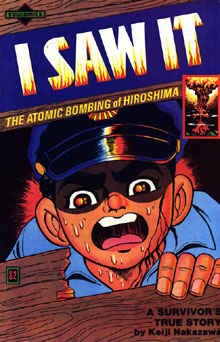
It was also a fun event for the folks I met there, one of whom was Leonard Rifas. Mr. Rifas was known to me by reputation; he teaches at a local community college and developed one of the first classes in comics (scroll down to HUM 270) in the region. We had never met, so it was good to make contact. I found out that Mr. Rifas was also the editor and publisher (at Educomics) of I Saw It, Barefoot Gen, and Gen of Hiroshima, which comprise Keiji Nkazawa's memoir of the atomic bombing of Japan. These books appeared about the same time as Maus but are overlooked. Gen of Hiroshima was one of the first graphic novels I bought for the library way back when, and Leonard was nice enough to give me a copy of I Saw It. Good stuff, the book and the evening both.


Tom Spurgeon started it as an audience response post, but Steve Flanagan turned it into a meme, so I'm chiming in with my "five good superheroes created since 1950 and not published by DC, Marvel or Image" in no particular order.

1. Captain Confederacy (Shetterly/SteelDragon) Pick any version you want, or even one of the other international heroes that inhabit Will Shetterly's alternate reality: they are all strong concepts and interesting characters. I raved about them some time ago.

2. NoMan (Wood/Tower) Again, just about any of the T.H.U.N.D.E.R. agents cold qualify, but the inherent loneliness and alienation of the character, buried deep in the sci-fi-spy trappings that surrounded him, is still fascinating. Wally Wood was doing better even work that he thought he was, I think.

3. Mr. A (Ditko/Witzend) As a pure, unrefined actualization of a creator's vision, it would be hard to top Steve Ditko's Objectivist Avenger. Although far from Ditko's best work artistically or narratively, the small ouvre is both challenging and compelling.

4. S'amm S'mmith, the Martian Manhandler (Friedrich/Charlton) A member of the Bestest League of America appearing in the Blooperman spoof strip, I have to give this guy props just for the best parody name ever and for being an antidote to the current Angry Broccoli Man characterization of the original. (Anybody have a scan of this strip?)

5. Jack Staff (Grist/Dancing Elephant) I think this is my only repeat from anyone else's list (Steve's was one) but that's okay: he only represents everything that should be good about superheroes and superhero comics today. But I've gone on about that before, twice.

Staff, Jack and dis-types


Jack Staff, Vol. 2: Soldiers
By Paul Grist and Phil Elliot
Image Comics: 2004


I read and reviewed Paul Grist's first Jack Staff collection a few weeks ago, so it's probably not surprising that I have devoured the second volume. Soldiers is a bit of a change from Everything Used to be Black and White in a specific way: it is in color. I don't want to say the color is bad, because Phil Elliott did a great job doing whatever all the things are that colorists actually do in this digital age, and the book looks great, but after reading a collection of twelve issues in black and white, it was a bit jarring, and Grist's illustrations are so strong they don't seem to need colors anyway.

The story itself continues to backfill Jack's history, filling us in on why (at the start of the first volume) he had been absent from heroing for twenty years. It features the now-familiar cast of reporters, cops, agents, robots, and supervillains, most of whom would be as comfortable on an ITC television series as in a comic book. Grist continues to develop his mastery of the multi-layered narrative and provides us with another ripping yarn, fraught with portent and hidden depth, but it is on three of those supporting characters whom I would like to focus today.

Becky Burdock, Vampire Reporter


A modern Nellie Bly in Annie Hall's castoffs, Becky is driven, dedicated, and competent; young, but no ingenue, and a decidedly non-nosferatic vampire, she is a professional whose agenda sometimes parallels and sometimes conflicts with Jack's. There might be the slimmest hints of the beginnings of some sort of romantic entanglement in their relationship, but mostly they find themselves circumstantial allies trying to survive the same catastrophes.


I have noticed that twice so far, Jack has responded to requests for assistance from Becky by saying he was too busy to help; Becky has gotten herself out of the situation anyway: so much for the damsel in distress trope. Jack had better be careful, or she'll stop letting him tag along on her adventures.

Helen Morgan, Q Branch


Morgan is the enigmatic lead agent of Q Branch, an X-Files-like unit that kicks a bit more ass than Fox and Scully ever did. She puts me in mind of what the Phantom Stranger might be like if he joined the civil service; mysterious and powerful, but in a mundane and quotidian way, a George Smiley of the paranormal. Her quiet presence drives and directs the efforts of the splashier coppers and super-cops, but she's not at all hesitant to get down and dirty when she needs to.

How tough is she? Well, in Soldiers, Detective Inspector Maveryk, consumed by a mysterious rage effect plaguing the community, surprises her and beats her to death with his police baton in an interrogation room, and then drunkenly awaits his discovery and arrest in the squad room. Here's the upshot:


Now that's tough - not a word, not even a look. Don't mess with Helen Morgan.

Liz Stewart, Special Military Intelligence, Lethal Executive


Were Bruce Willis a woman, he might be able to play Commander Stewart, if he could reign in his soft side. This hard-as-gravel military operative is strong, single-minded, and smart. Whether facing up to an out-of-control superior officer or fighting her way through a town of enraged killers, she is in control, and puts the "no" in no-nonsense. Here she is mixing it up with The Claw, a Q agent who is invisible except for his electric hand:


Stewart was introduced only this volume, but I am looking forward to seeing more of her - as long as she's not after me.

What do these three characters have in common? Besides being cool, they are all women. I know I recently read a post somewhere that argued against praising writers for writing strong female characters because, after all, that's just what they ought to be doing, and we shouldn't praise people for merely doing the right thing. I find myself forced to disagree with this position; sometimes doing what we should do, in the face of peer pressure or tradition or temptation or even just ease and inertia, is noteworthy, at least to the degree that such attention would encourage further good work. It is in that spirit that I single out Paul Grist for this particular praise.

Becky Burdock, Helen Morgan, and Liz Stewart are all fascinating and colorful characters and could have - and likely would have - been written as typical male characters by a lesser talent; I call this progress, of a sort. Each of them is a woman, but none is The Woman: each has a purpose, role, and a nature beyond her gender alone.

Yet, we get the sense that each one is fully-fleshed-out character whose gender is part and parcel of her makeup, not just a random characteristic chosen from a character-generation program for an RPG, or a checkmark on a diversity quota list. There is no T&A in this book, but if women are your fancy, I defy you to read this without falling a little bit in love with at least one of these characters, because they are all real and wonderful.

And that, my friends, is worthy of note.

Bonus Strong Female Lead: Patti Smith


This is the cover of the "What's Happening" section of the Seattle Post-Intelligencer, one of those inserts that come out on Fridays with arts and events calendars. The cover story features Patti Smith, who was having a show in town, and the story applauded her neverending battle against the commercialization of rock.

As soon as I looked at the cover, I got it, but to be test it out, I showed it to my partner, a non-comics-reading female person, and asked her what she saw. She almost immediately said "She's supposed to be Wonder Woman." I asked what made Patti Smith into Wonder Woman; she pointed at the tiara, and then noticed the wristbands as well.

Now, if that's not iconic status, I don't know what is. I don't care what anyone says, for pop culture reasons alone, Wonder Woman is, and always will be,one of the big three.

Now, if they could only get her comic right...

What some people without blogs are thinking

This summer, I am teaching two sections of English 102, a standard college composition class for which I use graphic books as texts. We have read The Language of Comics as an introduction to scholarly analysis of the form; our texts includes Showcase: Superman, Watchmen, Why I Hate Saturn, and Maus, among others. I have introduced some of Scott McCloud's theory as a basis for formal analysis (since just about every article in TLoC cites him) and we watched and discussed a History channel documentary to get some sense of comics in a cultural perspective.

My morning section of about twenty students includes only one person who has read comics to any degree; to the rest, this might as well be a course in eighteenth century French romantic poetry, for as much as they know about the form. Nonetheless, they are digging in and working it.

The students will write two papers analyzing their choice from among the texts (in addition to other assignments). I thought it might be instructive to show you what they thought noteworthy, or at least interesting enough to write about, for the first paper. here are some tentative thesis statements from our first workshop:

Though most of Watchmen tries to be liberal, there is still a theme of homophobia.

Color

Rorschach and Eddie are both main characters in Watchmen who happen to see their terrible world for what it is. Eddie embraces it and finds pleasure in the sickness, while Rorschach is depressed and lives in misery because of it. Although their outlook is the same, their reaction is different, and therefore compelling.

Dr. Manhattan’s destruction and then regeneration into a presumed perfect, god-like being can be paralleled in the book by a society needing to regenerate itself as well.

Although Superman comics are juvenile, simplistic, and made for kids, adults can also enjoy them. They teach a lesson that everyone can relate to.

That Superman/Clark Kent is not the perfect role model that he is made out to be.

Through the characters and images, Watchmen by Alan Moore and Dave Gibbons discusses some issues people face and can relate to.

Even though Dr. Manhattan wants to be with Laurie, Laurie wants to smash and break up with him.

While Superman is often thought of as a paradigm of the perfect being, deep inside this shell Superman reflects society’s fears, creating a parallel world where all these fears are overcome by a paradigm of the perfect being.

These stories in Showcase: Superman show that technology can help create a utopian-like society, but abuse of the planet to assist advancement could lead to our destruction.

Superman is a self-absorbed hero who puts himself first and the universe second.

Although conventionally seen as a psychopath, Rorschach is the actualization of personal reality contained within every human being.

Robert C. Harvey defined comic books as a blend between pictures and word. According to this definition, the pictures and words are vital to each other. Why I Hate Saturn by Kyle Baker is a comic book where pictures and words work against each other and this results in confusion for the reader.

As Superman’s friend, Jimmy Olsen helps Superman with some of the problems that occur, and as a character of the comic, the young readers can relate to Jimmy because of the role he plays.

Alan Moore closes each chapter of Watchmen with a famous literary quote. By using quotes as a template for his writing, Moore transforms the words of others into an underlying theme that helps develop the plot and progression of his characters.

The Superman comics use a narrative caption in nearly every panel; this word-image relationship allows the story to take place quickly and appeals to the younger audience.

Art Speigelman wants readers to be shocked by the strategically placed real photographs [in Maus]; he wants the reader to be forced into seeing the reality of the holocaust if only for a few moments in each book. Seeing these photos is more disturbing than the disjunction between animal characters and the horrifying plot.

Superman is a good role model for the children in teaching moral values.
Maybe about half of these statements are developed enough for a compelling paper, but they do include both formal and traditional literary analyses, as well as a few cultural inquiries; some of them would even get beyond the "no duh" response from jaded, long-time comics critics (well, maybe). I can't help but wonder what approaches I would get if I gave the same assignment to a bunch of fanlings.


I don't think I could have a comics blog without at least one graphic per post, so here's this:


When I was a kid, one of my favorite characters was Hank McCoy, the Beast. Not the furry blue cute-monster (I got the first appearance of the "new" Beast when it came out, and I didn't like it then) but the husky, barefoot X-man with the big vocabulary. (If only he had taken a Humanities major, he never would have gotten fuzzy...) Anyway, I had been hearing some good things about this X-Men: First Class series, so I broke down and picked up a floppy - Volume 2, #1 - hoping to see some old school action.

I was not disappointed: the series has enough youthful vigor, old-style sensibility, and humor to satisfy an old-timer like me. The X-men appear young, and interact like the less-experienced individuals they ought to have been at that point. Professor X is still professorial, but more human and real than Stan Lee or Roy Thomas ever made him. The Hank McCoy I knew and loved is there, with his specs and big words and formal style and warm byplay with Iceman. If this issue is any indication, I need to find the trade of Volume 1.

What was most surprising and worthy of note is that this is a comic book that I would unhesitatingly give to my daughter, if I had one. This particular issue focuses on Marvel Girl and some mentoring she receives from Sue Storm. Although Sue is still going by Invisible Girl, she is presented as a wise, capable professional with a lot to share. The interaction between Jean and Sue is understated, charming, and effective; it says more about nurturing our young women than any half-dozen PSAs combined, even with a couple of Nike commercials thrown in. Given the problematic treatment of women in superhero comics today, I applaud Jeff Parker for writing a story that had intelligence and sensitivity as well as chills, spills, and thrills (and include Roger Cruz for his unexploitative artwork).

Your primary medium is the knowledge and expectations of your audience

This weekend (Friday and Saturday) I had the pleasure of taking a class at the Pacific Northwest College of Art in Portland: CED 312-1, Graphic Novel: Narrative and Persuasion, taught by Scott McCloud.


Essentially, this a sixteen-hour lecture and lab version of the content from Making Comics, McCloud's latest book, a primer on how narrative works in comics(1). Although I have read and re-read the book (along with Understanding Comics), and use a lot of McCloud's principles and models when discussing comics in the classroom, I found the experience of working directly with McCloud very valuable. While I can't say there were revelations and new insights to be gained from the class for someone familiar with McCloud's written works, the practical application of techniques and the peer and instructor critique added a depth to my understanding.

The student made up a mixed bag. Some were matriculated students at PNCA taking the class for credit; for some people this was the end of a week-long course in graphic novels that had included other classes (one taught by Trina Robbins); some, like me, were just taking Scott's segment. Some were already comics creators or wanted to be, but that was certainly not universal: one fellow was looking at all forms of narrative to find an idiom in which to present his memoirs and another guy was a mediator looking for new models of creative thinking. The class of thirty or so was split about evenly between men and women; the youngest student was a 17-year-old girl and there were at least two men in their sixties, with the rest of us spreading out between the extremes.

Scott started the class with a slide show that outlined the typical steps in the creation of a comics narrative - plot outline to script to layout to pencils to inks - and then explained how any or all of them could be omitted or truncated.

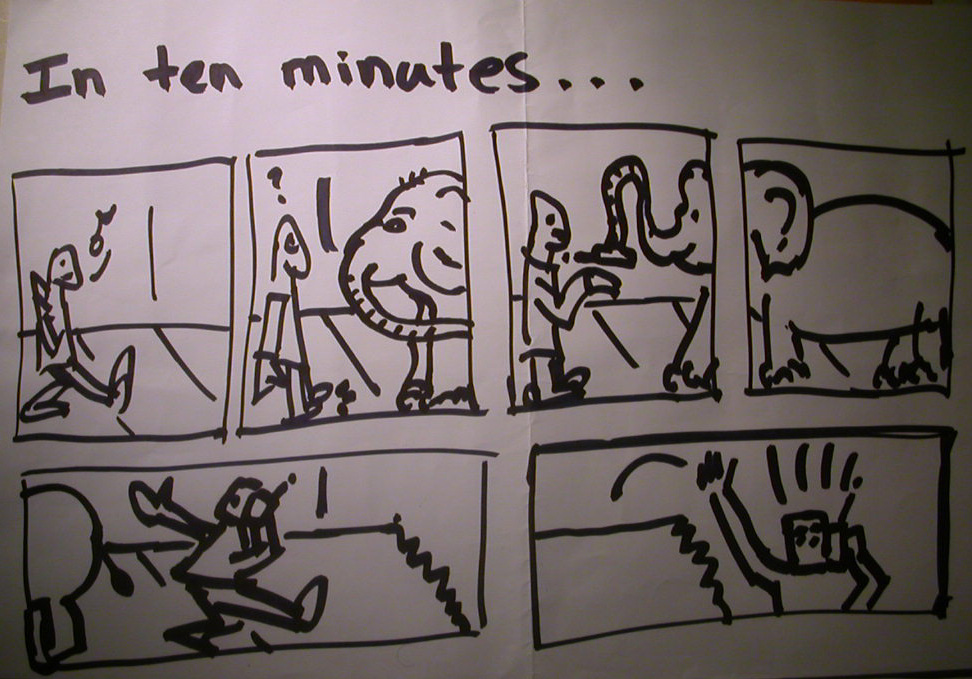
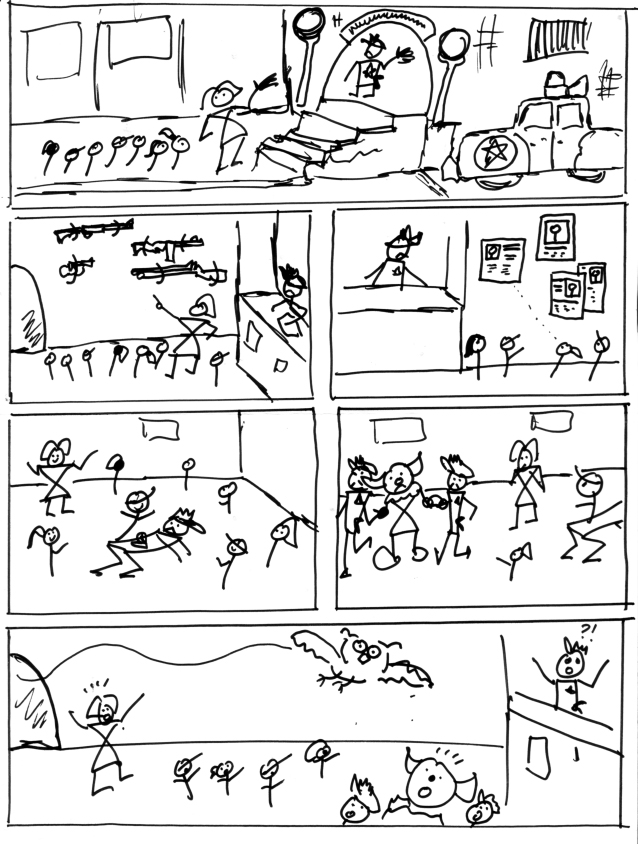
This led into an exercise that replicated the guy-finds-a-key story in Making Comics (page 11): Scott gave us a short story summary(2) and we had ten minutes to create a strip that told the story as we understood it. Students took from three to fourteen panels to compose the narrative; I took five (or six, depending on how you count) - how many would you use?


As we critiqued each and every strip in panel number order, we could see clearly how the tension between economy and detail worked itself out in each person's creative act and the choices they made(3).

"Choices" is, of course, Scott's overarching conceit for the creative process: he breaks down comics creation into Choice of Moment, Choice of Frame, Choice of Image, Choice of Word, and Choice of Flow. The panel count, for example, is one aspect of a creator's Choice of Moment: how many are necessary to tell the story you want to tell?

The class was not designed to go into much detail regarding Choice of Flow, which is concerned with page-level layouts and alternate web layouts(4), but we continued with more lecture on Choice of Moment (including a review of the six types of panel transition(5)) and moved into talking about Choice of Frame and the balance between clarity and intensity. We looked at stories by Moebius, Drooker and Huizenga to illustrate the concepts being discussed, and it tuned out that reading comics on a big screen worked surprisingly well.

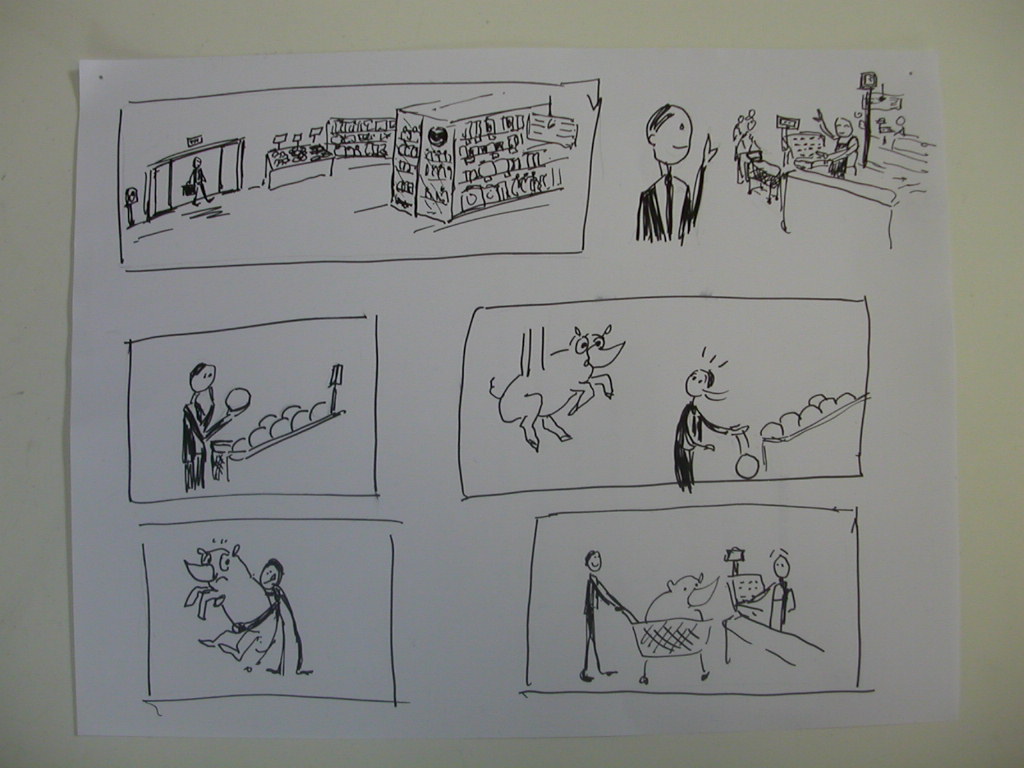
We then moved into the studio for some extended exercises, the first of which was rendering (in twenty minutes) a six-panel script that deliberately included disjunctive elements. This narrative quirk compelled a high degree of clarity on the part of the creator, since logical extrapolation would not help get a viewer to the message. This strip by a classmate(6) is a good illustration:


The representation of the supermarket activities in the first three panels is spot on and entirely clear; the introduction of "a rhino falls from the ceiling" in panel four works less successfully, since the rhino looks a bit like a pig with a mask on, and without any contextual clues, the closure that gives a reader "rhino" was not certain. In this case, it did not seem to be a question of Choice of Moment (that was specified in the script) or Choice of Frame (it seems fitting), but just Choice of Image (and more practically, no chance for a reference image).

In the interest of full disclosure, here's my strip for the same assignment. I had a slightly more complicated script and executed it with much less skill:


We all completed different strips like these and reviewed them in small groups; each group selected one strip for a larger discussion. The relative clarity (or lack of it) as a result of creator choices was apparent.

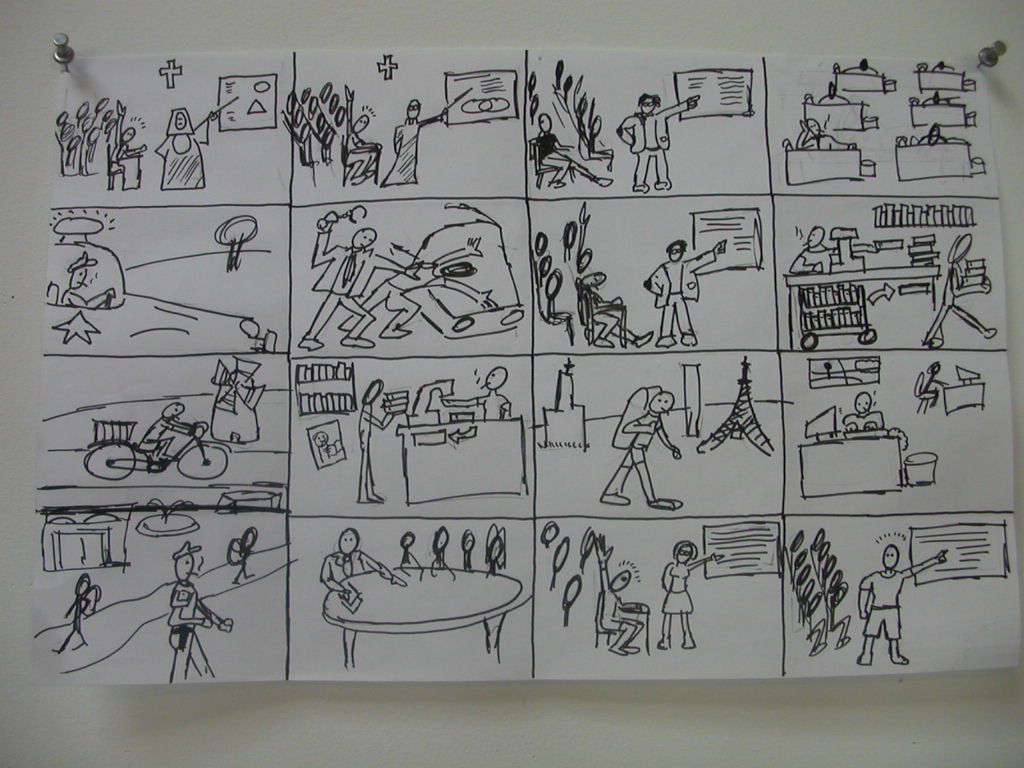
We followed this activity up with an even longer strip: the instructions were to use a straightforward four-by-four, sixteen panel grid to create a narrative based on your own life. This became a two-level exercise for me. On the one hand, it was a more in-depth look at the same kind of choices as we were making in the short strip: since the details of our lives were personal and peculiar, clarity of presentation was extremely important so the specific details of the narrative could be understood.

The second level, however, resonated with me more as a teacher of writing: many people began by depicting their birth and ended with coming to the class we were in, and were dissatisfied with their attempt to accurately depict their entire lives in just sixteen panels. Very few students chose to move to the specific rather than the general and to tell the story of just one aspect of their lives. This approach, which I took (showing only education and employment) might give a narrative which is less comprehensive but more solid, with a clearer narrative arc. Here's the strip:


In any case, the exercise stretched people's creativity (we had only an hour and twenty minutes for the whole thing), and the critique - Scott went over every piece in detail - took the end of Friday and the first hour of Saturday, and covered Moment, Frame, and Image.

Saturday morning continued with a lecture on character design as an example of Choice of Image (with what seemed to be a slight digression into the "shape of storytelling"(7)). Then the presentation turned into more of an art class, with Scott demonstrating the look of the six emotional primaries - anger, fear, disgust, joy, sadness, and surprise - and showing how the secondary, more complex emotions were combinations of the physical elements that make up these primaries. Much of Saturday was filled with studio exercises in communicating different emotions through facial expression and body language. My attempts at illustrating these gradations were not successful enough to add anything to this account, but you can see some other versions on the wall in this photo.


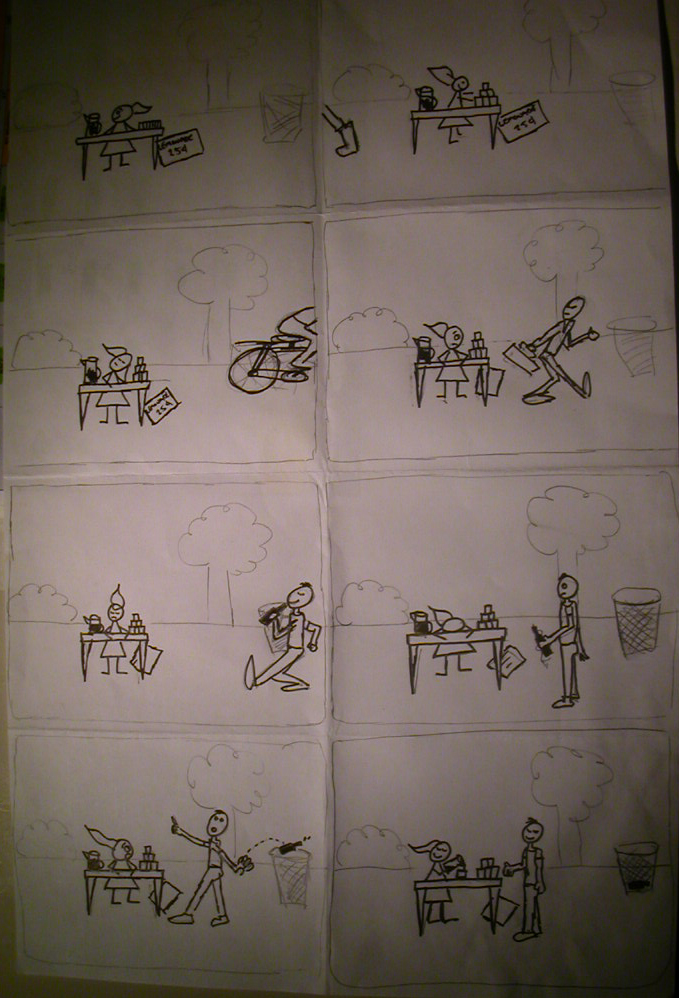
Our final project was to create a fully developed narrative strip (in ninety minutes) that demonstrated our understanding of the Choices. For better or worse, this is as good(8) as my understanding got:


Overall, I have to say that I was impressed with Scott McCloud as a classroom instructor. He is clear, personable, and accessible, and presents the material in a manner that models collaboration with the student rather than preaching. For me, the class was more review than enlightenment, but it was a rich and textured review that increased my confidence with the material. Unfortunately, due to technical glitches, Scott was unable to present his lecture on Choice of Word, the segment that might have been of the most interest to me, but I still got a lot out of the entire experience, and took away some ideas for my classes.

If you ever have a chance to take one of these classes, do it.


(1) Notwithstanding Neil Cohn's recent post on nomenclature, I continue to use comics as the shorthand for sequential art, however we may wind up ultimately defining it.

(2) For the record, the summary was A man walks down a sidewalk, whistling. He meets an elephant, who gives him a cell phone. He thanks the elephant and continues walking, talking on the cell phone. He then falls off a cliff.

(3) This tension reminds me of an approach to judging the best length of a written piece: use as few words as you can and as many as you need to. (This is itself a paraphrase of advice I heard from a driver's ed instructor: drive as fast as you can and as slow as you have to.)

(4) Although that didn't stop me from responding to the latest post on the wonderful Remedial Comics.


(5) Moment-to-moment, action-to-action, subject-to-subject, scene-to-scene, aspect-to-aspect, and non sequitor.

(6) For the record, I don't think anyone in the class was more fluent in the language of comics than this creator.

(7) McCloud held that you can't have a story unless someone wants something, and that the three templates are "desire achieved and then rejected" (Wizard of Oz), "desire denied and then rejected" (It's a Wonderful Life), and "desire achieved" (The Little Mermaid). I had not encountered this model before.

(8) Scott took this strip apart kindly but quite thoroughly and pointed out lots of places for improvement. He also didn't like that the "achievement of desire" came about more through the kindness of a stranger than the girl's own effort, which seems a valid criticism.

Note: The post title comes from McCloud's mantra all weekend.

Comicons make me sad

Over the weekend, I went to a comic book convention. Before you get excited and think you missed something, this was the Seattle ComiCard Convention, which compares to CCI as Yakima Valley Community College compares to Columbia University. It was basically just a dealer room with a three-table artist's alley, and it only lasts seven hours, and it draws about .1% of the attendance at San Diego, but it only cost $3 and a can of food to get in, and all I really wanted to do was look for some back issues, so it was all good.

Well, maybe not all. It had been a long time since I had been around a large group of comics fans, and I hated to see the stereotyping about lack of social skills being borne out. I have been to a lot of conventions, conferences, and trade shows, and there is a certain etiquette that everyone, by and large, abides by to make moving a lot of people in a small space feasible; this social agreement involves being aware of where your body is in space, recognizing that you are not the only person in the room, and so on. This agreement was honored more in the breach than the observance at the con, but that's not what made me sad.

I was also disappointed by the apparent lack of concern on the part of most of the dealers for simple customer service. I could tell they all wanted to make sales, but few of them seemed to be reaching out to the customers in any valuable or productive way; they seemed more concerned with talking and joking with each other. I was looking for some back issues on Unknown Soldier at one booth; the dealer told me he had only brought his DC comics from A to Sh, because that's all that would fit in his truck. "By alphabet" seemed an odd way to choose stock for sale. But dealer behavior was not what made me sad.

It was great to see on display all the old silver and bronze age stuff that I remembered buying back in the day, long gone from my collection: Steranko S.H.I.E.L.D. covers, titles like Tales to Astonish featuring two different series, John Severin covers for Sgt. Fury; all the Neal Adams covers for various DC titles, anthology books like Our Army at War and Star-Spangled Battle, The Brave and the Bold books with Jim Aparo covers. I could recall the sense of wonder that I had thirty-five years ago, finding these books and encountering all these new possibilities - in art, in narrative, in characters, in whole universes. Was it Isaac Asimov who said that the golden age is twelve? Looking nostalgically at these comics, I realized that I did not really want to buy them so I could read them again; I wanted to read them for the first time, with wide eyes and an open heart. But it was not the realization that my youth has fled forever that made me sad.

What made me sad at this con was looking around at where superhero comics have gone since they filled me with that wonder. I don't want to give up on the genre; I grew up with it, it helped form me, and I actually enjoy its tropes and conventions. But the industry has not only forsaken the young, it has not developed much for the eager adult, either. Comics today seem to be Soprano-style soap operas in tights: convoluted plots, written for the cognoscenti, routinely involve rape, murder, and dismemberment, feature morally ambiguous if not repugnant protagonists, and frequently span titles in company-wide mega-events that are more flash than substance. All the blood and thunder doesn't seem to be in service of anything: Cymbeline and Titus Andronicus are gory tales, but as well as shocking and entertaining the audience, they say something bigger than "violence is cool." I don't know if that can be said of Identity Crisis. And let's not even get started on the juvenile objectification of women that is so prevalent in the genre.

I know that there are some great comics and graphic books out there, and I have written about some here. Pride of Baghdad. Jar of Fools. Castle Waiting. I love and appreciate the work creators are doing in all sorts of genres. But what has happened to the cape and cowl set? If you like the current preoccupation with sex and violence, you're all set; if not, what? Where am I to turn, not just for a superhero comic suitable for my niece or nephew, but one that is suitable for me? Where are the idealistic action tales, full of the wonder and the glory of science and adventure and exploration and justice, for the kids? Where are the more complex treatments of superheros, the noir-themed adventures, the picaresque romances, the allegories, the comedies, for the adults? Are superheros mutually exclusive to both innocence and sophistication?

I don't want warmed-over memories or ultimately vain attempts to recreate the books of my youth; I want robust, intricate stories, set firmly in the genre, that engage my imagination, intellect, and emotions. Is that too much to ask?

Because it would make me really sad if it were.

Double feature: Who Watches the Crusaders -and- The Scarlet Avenger

Since Mikester hosted a long discussion about it on Progressive Ruin, it seems that everybody knows, or should know, or won't admit to not knowing, that Alan Moore's seminal / ground-breaking / classic / post-modern /critically-acclaimed (pick any three) graphic novel, Watchmen:


was originally intended to feature DC's then-newest property, the recently-acquired Charlton heroes:


This plan was eventually vetoed by TPTB at DC, and Moore invented a whole new slew of mystery men for the story (some say to the benefit of the narrative).

What many perhaps do not know is that Moore originally played with another set of heroes in developing the notion that eventually became Watchmen: the MLJ/Archie characters:


As the comments to Mike's post will attest, I did not know this factoid, or I perhaps had known it but forgot: it was also covered in the Comics Urban Legends feature of Comics Should be Good over a year ago.

At any rate, once the idea was put into my head, I couldn't get it out. I wish I could draw so I could do a pastiche of some of Dave Gibbons's panels, substituting the Archie heroes in place of Moore's characters. The difference in intent, tone, and context between the two sets of characters couldn't be greater; their juxtaposition is crying out to be realized somehow.

In lieu of creating anything artistic, all I can do is speculate on the correspondences.

I know that injecting yourself with super-helium is not really the equivalent of becoming one with the quantum universe, but I think the Comet has to take Dr. Manhattan's role, for want of any other candidate.

I like The Fly for Nite Owl, even though he lacks the legacy aspect; unfortunately, Fly Girl is the only female character with enough stature to stand in for Silk Spectre. Perhaps we could add some estrangement to the mix to make that work.

Jaguar has the traveling-to-foreign-lands part of Ozymandias's background; we could dress up the rest.

For the doomed Comedian, perhaps The Shield or a grim 'n' gritty Captain Flag.

Finally, I think the only character that could even begin to stand the weight of filling in for Rorschach would be The Hangman (not pictured in the pin-up).

This is only a first draft; do y'all have any more insightful interpretations? I turn this over to the power of the internets.

:::::::::::::::::::::::::::::::::::::::::::::::::::::::::::::::::::::::::::::::::::::::::::::::::::::::::::::::::::::::::::

Here's the text of an email I received today, from a fellow who obviously checked out the interblogwebosphere for likeminded folks:

Hi, there.

I see that you're a big 'Spy Smasher' fan and thought you might be interested in checking out my short student film, 'The Scarlet Avenger', on Google Video. It's a rip-roaring adventure, based on all the 1940s matinee serials that inspired movies like 'Raiders of the Lost Ark', 'The Rocketeer', 'The Shadow', 'The Phantom' and 'Sky Captain and the World of Tomorrow'. You can catch it here:

Movie link

Note: You can watch it in real time, but it looks way better when you download it (after downloading the free Google Video player). Doesn't take long at all.

It's my dream to turn the short into a feature-length motion picture. I will be chronicling this great adventure on my blog:

Blog link

On the site you'll find links to a high quality podcast version of the short, rare behind-the-scenes footage, outtakes, fan reviews and artwork, and much more. Hope you enjoy it and look forward to hearing from you.

Sincerely,

Scott C. Clements
Toronto, Canada
Well, I took a look at the film, and while I don't know if there's a feature film in there, it was competently made and professional enough for me to share it. I'm not sure about the hero's costume, but the movie seems to hit all the right notes. Who knows? This guy could be the next Spielberg, and we can say we were there when it all started.

Comix in paradise

In between relaxing on the beach and, well, doing even less than that, I decided to stop in at a comic book store here on Maui, just for curiosity's sake. The only place I could find was Compleat Comics in Kahului, the area near the main airport in the center of the island (right where the two big masses meet). The website seemed to indicate it was a pretty elaborate shop, so one day, after coming back from watching the windsurfers near Pa'ia, we stopped by.

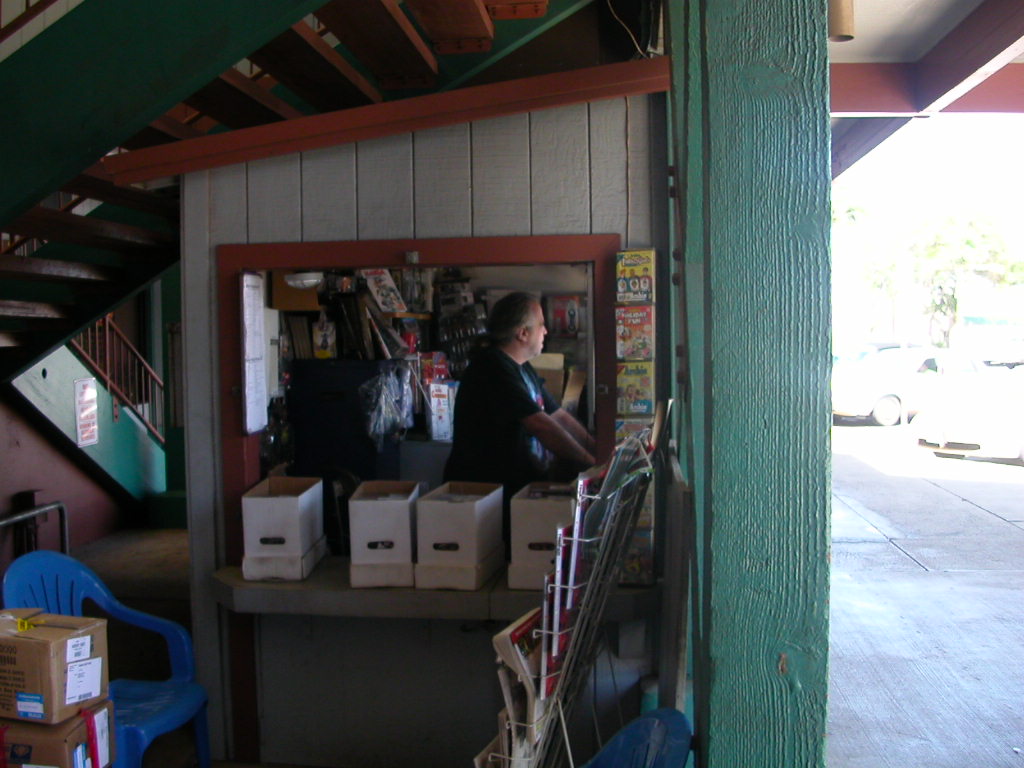
I was surprised to find that the store is no more than a kiosk, the kind you can find in a mall selling cell phone covers or sunglasses or Hummel figurines; of course, since this is Maui, the kiosk is at a mostly-outdoor shopping center.


I found that most of the stock did not seem to be comics: there were lots of card sets, like Magic, and a lot of manga (which I guess makes sense), and a few action figures, and not many comics on display at all. In fact, one of the most prominent display spots was given over to a DC superheroes sticker book, and all of the new comics are sold from four short boxes:


I talked to the fellow a little bit, and he said that he had had a much larger space for over twenty years, but lost his lease and had to move. This place was temporary, and had been for about two years now. (That must be island time perspective.) He didn't seem too concerned about finding more room and even joked about being the world's smallest comic book store. I guess a lot of his trade is by mail; it would have to be for any back issues - there was none in the store.

So, if you're ever in Maui, check it out; it's right next door to a great organic foods grocery store and deli - stop in and try the veat loaf!

Links:

Compleat Comics

Down to Earth

Oh, and I bought two singles just to be polite: Ant-Man #6 and Wonder Woman #5. Ant-Man made me feel like narrator-ant who opened the book: I am bored and falling asleep. This title is starting to feel like a SNL skit that has gone on too long. Wonder Woman wasn't bad, although it felt a bit like a book-length PSA. There was nothing in it to make me want to continue buying the title, however.

I was going to leave the comics in the condo rec room for another guest to read, and then I had this thought: The WW cover calls to mind the sense of wonder as well as the innocence that most people would associate with Superfriends or some such interpretation of the character. The issue, however, deals seriously and authentically with aspects of domestic violence, and ends with a scene of carnage that is not for the squeamish. In the end, I will take the issue home rather than leave it around for some unsuspecting parent to give a child.

Geez, when did superhero comics get so complicated?

Nuff Too much said!

I wanted to express just how much I care about the Startling Development in the Marvel Universe over the recent "death" of one S. Rogers, so I have enlisted the aid of the Badly-Drawn Atom of Earth-Filmation to help me.


As you can see, Earth-F Ray has shrunk down to submicroscopic size and found a tiny piece of dust mite dung, which represents both the degree and tenor of my response. But then, I haven't read any of Civil War, so maybe this event actually was a key moment and a useful dramatic device that rose naturally from a compelling story; who am I to say?

All I know is that today was the first day since... well, ever that my sister actually mentioned comics news to me.

In my LCS

I was in the LCS the other day, and I noticed a woman come in who just appeared too normal to be a regular comics buyer. I chastised myself for unsupported generalization, and then had my guess confirmed when she asked the clerk if the store carried Little Lulu comics. The clerk (who also happened to be a woman) took her over to the all-ages rack and started to show her the stock. I overheard her explaining to the customer clearly and without condescension which books were reprints and how reprint collections worked. She mentioned a Dennis the Menace collection, which the customer thought was very cool, and then started to turn her on to some newer stuff. The transaction seemed to be going successfully from all sides.

I offer this vignette as a bit of a counterpoint to the comic shop horror stories I have read, those anecdotes about rude, obnoxious, or sexist clerks who can't see the forest for the spandex. Comics is a lot of things, and the more the merrier, I say.

At the same time this heartwarming exchange was taking place, I was scanning the shelves, looking for my weekly supply of , um, spandex, and you know what? I came up with nothin'. Wonder Woman, the only remaining monthly (heh) that I am really interested in (since Ant-Man's rough charm is fading fast ) has apparently taken a detour into the Twilight Zone. The recently ballyhooed Countdown holds no interest for me; I dropped off the 52 bandwagon around thirty or so because the quality just wasn't there, and I have no reason to expect this "event" to be any different.

So, I think is is finally the end of my buying pamphlets: the kick just isn't worth the effort anymore. I hadn't bought anything new for years when I started this blog; all the interactions with blogger colleagues and my feeling more connected to current events tempted me back to buying new funnybooks, but the dalliance has left me unsatisfied. So, it's back to the trades for me; I have a list as long as my arm, and I'm going to start working my way through it seriously for a while.

And maybe I'll pick up some Little Lulu along the way.

Through the cracks

Somehow, Dance of the Puppets fell off my RSS feed and I have missed Marionette's blog for a longish while. Since I consider her my oldest blog-buddy, and since she was involved in a bit of a kerfuffle during that time, I feel a bit bad for having not been there. I don't want to go over all the gory details here, I just want to shout out to Mari with some old school Mike Sekowsky - Bernie Sachs goodness:


:::::::::::::::::::::::::::::::::::::::::::::::::::::::::::::::::::::::::::::::::::::::::::::::::::::::::::::::::::::::::

I mentioned a few weeks ago that I am using graphic books as the reading texts in the composition class I am teaching this quarter. After plowing through The Language of Comics, which gave the students a grounding in academic analysis of the form, we have read Showcase Presents: Superman Vol. 1; Watchmen; Why I Hate Saturn; and True Story, Swear to God: Chances Are*. We are currently reading Julius Knipl, Real Estate Photographer: The Beauty Supply District*, and have Contract with God up next.

This group of students are actually pretty good writers for this level, and, surprisingly to me, many seem to be drawn to formalist analyses as opposed to more traditional literary analyses of the books. There seems to be a good number of them who want to try to work out and evaluate the artistic and storytelling choices such as page layout, balloon use and placement, art styles, and so on; I even had one student ask me why we weren't reading McCloud (who is referenced in just about every article in LoC.) Now that we are working on a synthesis paper, more students are proposing examinations of themes and elements like setting (one student is doing an interesting look at point of view in Watchmen), but that formalist bent is still here.

Other than that, here are a few observations, for what they're worth:

1. Readers aged 16 - 25 who are unfamiliar with comics (most of the class) don't think that silver age stories are whimsical or charming; they think the stories are stupid and childish. (One student did a good paper on the "lying narrator" in the Superman stories.)

2. Watchmen is not a crossover title, but Rorschach is fascinating to readers.

3. A student pointed out that the book that Anne has completed at the end of Why I Hate Saturn is Why I Hate Saturn. I had never thought of that; another reason I love teaching.

4. Chances Are was by far the most accessible of the works we have read. (Perhaps it's just the least dated?) The consensus of the class was that if they hadn't known it to be a true story, it would have been trite and predictable, but knowing that it was true made them enjoy it a lot. One student called it "girly," but in a positive way.

All in all, it's turning out even better than I expected.

*What is it with these really long names for graphic books?

Pride and Perdida

I had a chance to read two graphic books over the break, both of them gifts: Pride of Baghdad by Brian K. Vaughn and Niko Henrichon (DC Comics/Vertigo) and La Perdida by Jessica Abel. I was not disappointed by either.


Pride of Baghdad relates the fact-based story of four lions who escaped from the Baghdad zoo in the aftermath of the the bombing that began the Iraq war. Beautifully illustrated and colored in tones that make the reader feel the desert heat, the story follows the small pride - an old male, two females, and a cub - as they wend their way through a world previously unknown to them, encountering wonders and threats, both human and animal, natural and artificial.

As we follow the group, our interest in engaged and held not by the plot - which is rather picaresque - but by the characterization. Vaughn's dialogue and Henrichon's art instill each lion with a distinct and credible personality. Each cat becomes a real personality, but never a person - their animal natures, sensibilities, and perspectives are never lost. Whether negotiating with gazelles or examining the rubble left behind by battle, these are wild predators following their instincts. While we can relate to these feline protagonists, there is never the sense that they have been anthropomorphized: it is we who are transformed, seeing the world through their cats' eyes:


There are very few humans in the book, yet it is a story of personal drama as well as adventure. And it has the most breathtaking and moving conclusion of any book - graphic or traditional - that I have read in a long time.


La Perdida is the story of a callow and naive American woman who moves to Mexico in an attempt to connect with her roots and find some greater, more "authentic" meaning to her life.

Having completed the book, I am impressed (from my usual formalist position) by Abel's command of storytelling: the narrative is intricate and the cast is large, but Abel maintains control of scene and character and builds plot upon subplot with foreshadowing, subtle clues, and the neat tying of threads. It is a quite a consummate work, helped my her masterful handling of the bilingual nature of the dialogue.

During the reading itself, I was less... engaged? Excited? Committed? This was mostly because I didn't like the protagonist, Carla, very much; I sometimes wished that she would just shut up and go away for a while so the story could follow someone else more interesting. Here she is (in white), pissing off a potential ally to a mutual friend in big trouble.


As the novel came to its conclusion, however, what I thought was going to be just a melodramatic climax turned into a revelation that Carla had been a pretty unreliable narrator for most of the book, and that her growth and struggle as a character were really just beginning. The wrap-up of the story was riveting, since Carla was finally doing things that made me care about her. I'll credit Abel with a lot of courage for not taking the easy way out and giving us a warm and cuddly heroine with whom we could identify; sticking with Carla was work, but it was well worth it.

::::::::::::::::::::::::::::::::::::::::::::::::::::::::::::::::::::::::::::::::::::::::::::::::::::::::::::::::::::::::::

Winter quarter started on the second; this is the term that I am using graphic books as the readings in my composition class. I was going to begin with some essays from Give My Regards to the Atomsmashers, a collection of essays by popular writers on the effect comics had on their lives. That book was out of print, however, so i had to make a last minute substitution with The Language of Comics, a collection of more scholarly articles such as "The Voices of Silence: Willette, Steinlen and the Introduction of the Silent Strip in the Chat Noir, with a German Coda," by David Kunzle. It's pretty heady stuff, grad school reading really, but the class is giving it a fair go. They're handing in their first paper tomorrow- an annotation of one of the articles - and we'll see if my optimism is founded. We'll be looking at and writing about extant criticism for a couple of weeks, and then they'll be trying their hand at analyses of graphic works.