One book I borrowed from the library was Jeph Loeb and Tim Sale's Superman For All Seasons (DC Comics: 1998). This was a book I had seen in its original single-issue format and decided to wait for the collection; once the TPB came out, I looked at it a few times but never picked it up. Having a chance to read it at my leisure for free was all it took!
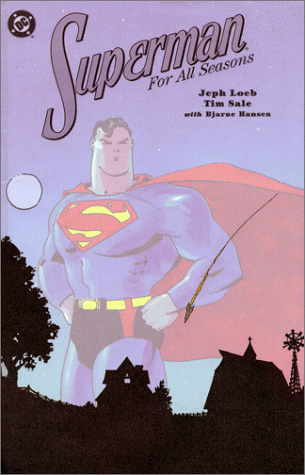 In the end, I'm glad I waited and waited, because I don't think I would have been satisfied with this purchase. I know there has been a lot of praise heaped upon this work, but I didn't think it was all that successful a piece.
I think I got what Loeb was trying to do - the whole Norman Rockwellization of Kal-El, if you will - and I can appreciate where that approach comes from - showing that Superman might have started as an alien, but has become a naturalized American, through and through. I just think the presentation was a bit heavy-handed, and inaccurate, to boot.
Clark Kent's homespun beginnings and influences - delivered mostly through Pa Kent's ruminations and amplified by the LLs' caption boxes - are just too saccharine and simplistic; I can't imagine getting the moral grounding to deal with near-infinite power from such homely truisms and conventional wisdom. "We each do what we're able to, Clark, some less, some more," Pastor Lindquist tells him. Is that empty homily supposed to help a superman make decisions?
It also bothered me that the Kents seemed so middle-of-the-road; I liked the early, left-leaning, fatcat-bashing Superman of the Golden Age, and always imagined Pa Kent as an old Wobblie with some shady anarchist connections from his early days, who moved to Kansas from West Virginia after the Matewan Massacre or something. And maybe Ma was a suffragette and a socialist. I mean, Clark had to have gotten those political leanings from somewhere. I didn't see any populist or progressive attitudes on display in Smallville.
Sale's art follows along with the story themes very closely - which is to say, a bit over-the-top. I liked the cartoony style and the bulky Clark; that was cool. The Kents teetered on the edge of gnomish, however, and the art direction was all over the map: the faux-forties in Smallville and retro-future in Metropolis I can see, but the seventies Luthor-suits, the oh-so-nineties Toxin (puh-lease), and the contemporary (ballcap-backwards) kid seemed jarringly out-of-place as a result.
Which is not to say Sale didn't do some great stuff anyway and try to develop a consistent visual vocabulary: for example, the composition in this panel, repeated several times, was a great artistic device linking the boy from Smallville to the man in Metropolis.

In any case, the book wasn't bad, I just didn't think it was great. It was certainly several orders of magnitude better then the execrable World of Metropolis, which it resembles structurally.
I'm glad the library had it.
*Way back in the dark ages of 1994 or so, I was instrumental in developing the first specific comics collection in the Seattle Public Library. My branch managing librarian got an allocation for a special collection and let me spend it on comics: I remember buying Maus and Barefoot Gen, but can't recall what the rest of that initial collection comprised.


