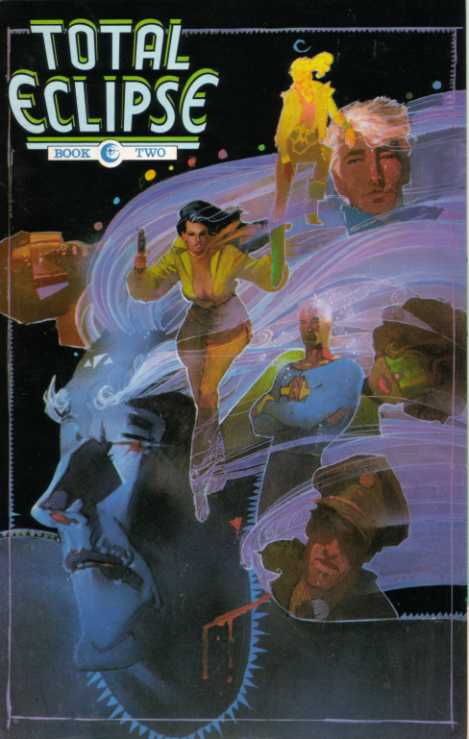
This got me thinking about a different GCSCE, one that is in the Last Shortbox. It is a five-part prestige format miniseries, graced by superb Bill Sienkewicz covers:
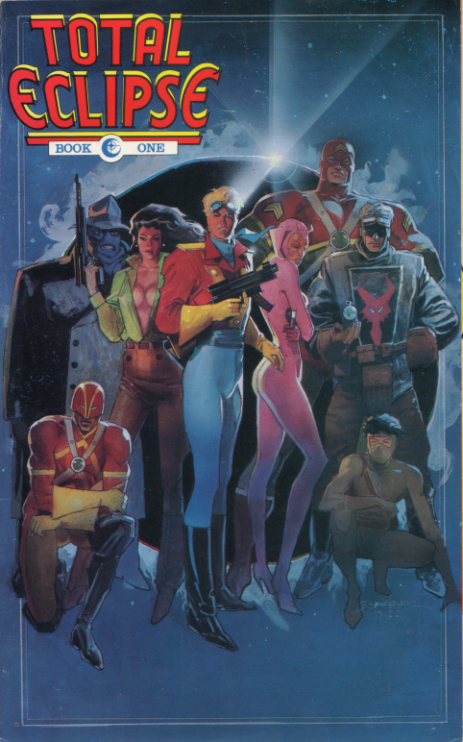
Total Eclipse Nos. 1 - 5, May 1988 - April 1989, Eclipse Comics
Writer: Marv Wolfman;
Penciller: Bo Hampton (et alia); Inker: Rick Bryant (et alia)
Eclipse Comics was an independent making a run for the big time back in the eighties. They had some very interesting properties: the whole Airboy family of golden-age aviation-related heroes, including Sky Wolf, Valkyrie, The Flying Dutchman and others; original stuff from the mainstream Spidey-esque Prowler to the oddball time-traveler Aztec Ace; disparate insider characters Miracleman and Destroyer Duck; supergroups like New Wave; and the one-of-a-kind Beanworld were all published under the Eclipse imprimatur.
I read some of their offerings back in the day, but I wasn't a big fan, by any means. I probably bought Total Eclipse because I wanted to sample the line, as it were, and kept it mostly as an historical document. It has been over fifteen years since I first read it and likely ten since I last looked at it; the long span of time between 1988 and now is enough for me to have forgotten most of what I might have known about the characters. I figured this would be a good test of the appeal of the GCSCE: would this epic be accessible to a relative stranger, someone who was unfamiliar with the characters and the motifs, even if predisposed to the form?
Well, in a word, no.
To tell you the truth, I couldn't even really read the thing - it's nearly incomprehensible. There's some kind of plot about a reluctant immortal named Zzed who wants to commit suicide but can't, and who somehow gets involved with a bad guy named Nine-Crocodile, and there's some sort of cosmic maguffin that everyone is after, and different realities are blending into each other, and heroes meet and punch stuff to set things right. Whatever. In any event, there's so much that has to happen to make all these people meet each other that is just seems too complicated to follow or care about, especially if there's no special resonance with the characters already in place.
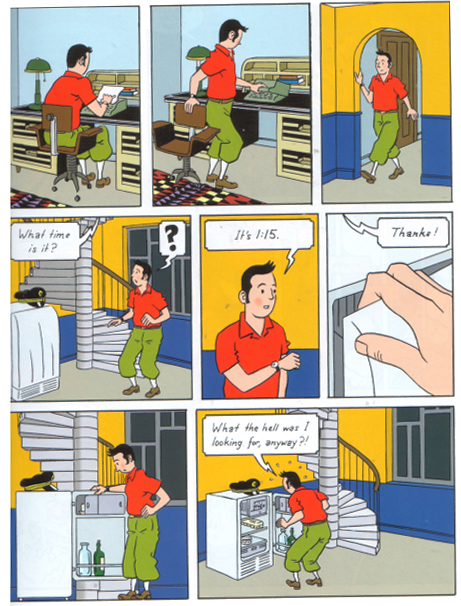
On top of this, there's just too much else to do while trying to tell the story. First of all, every character has to be introduced with his or her shorthand background story, so we get deathless internal monologues such as this one from the Prowler:
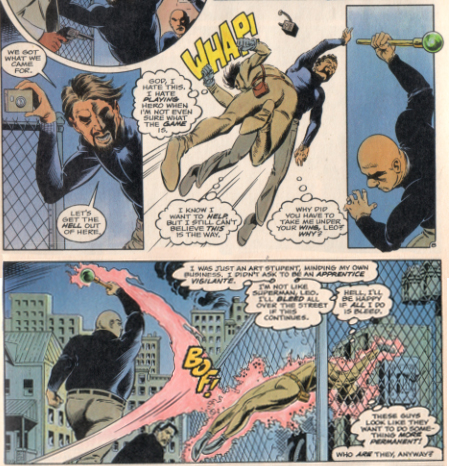
Shades of the Silver Age! Scipio would love it, but it sure gets old as character after character is introduced.
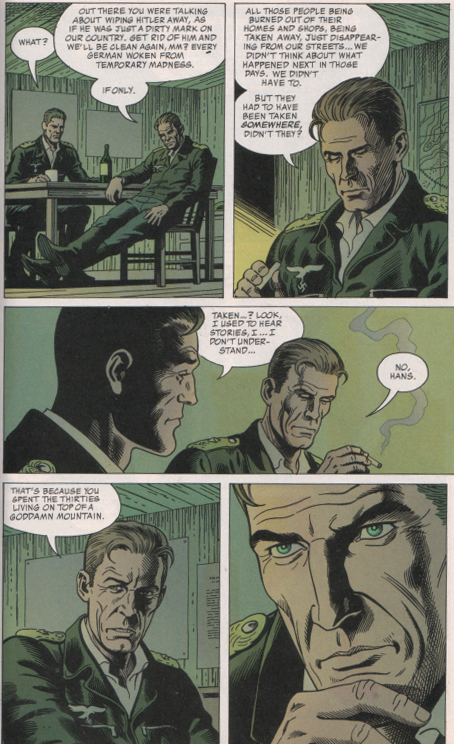
Even worse than the introductions are the juxtapositions. While the book tries to stay with a core group of heroes that seemed to complement each other, trying to shoehorn in every character published (that was the total in Total Eclipse, see?) at some point was an unworkable self-restriction. (I think it worked okay in DC's Showcase #100, but that was just really just a 64-page stunt.) It lead to a lot of dissonance, as this page with Spirit-homage Masked Man, Millie-the-Model-homage Max and Mo, and noir heroine Ms. Tree all responding to the same eclipse shows:
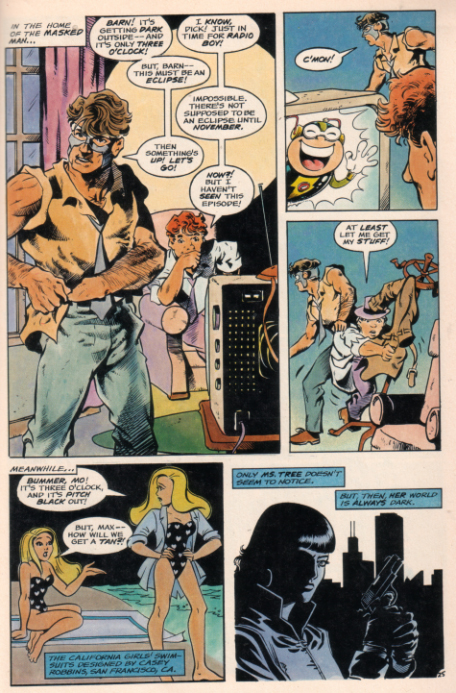
I think as a dramatic device, that worked about as well as that time that the cast of Friends was caught in a blackout that Kramer caused on Seinfeld.
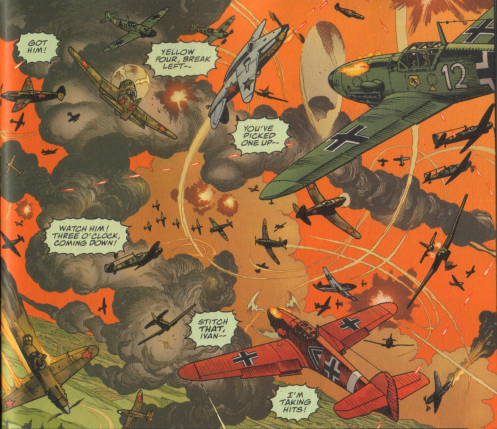
But of course, it's really all about the tights 'n' fights, so we are treated to specatular battle scenes such as this one:
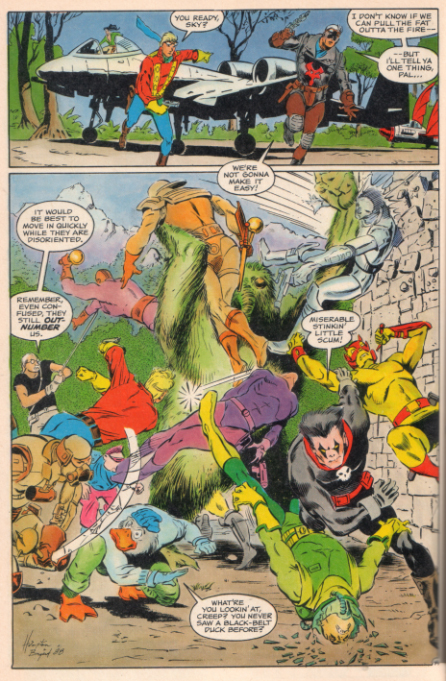
The bad guys aren't the only ones who are confused - I needed to flip back through the pages to see who was who, because I couldn't tell a lot of the time.
The upshot? I had fond, if vague, memories of this series and wanted to like it. Looking at it somewhat objectively, I have to say that if its task was to lure in new readers, it wouldn't have worked with me. There are a few moments of grace and humor, but overall it just seemed like a relentless crossover engine that just kept chugging along, shoving a new character into my face every few pages or so, characters who, however lovingly crafted by their creators, were reduced to stereotype in these pages. What this means in the context of Infinite Crisis or Civil Wars or whatever is next down the pike, I can't say for sure, but I think I'll likely give the next GCSCE a pass, as I have done for most of them.
But Total Eclipse sure did rock some great covers: